Me llamo Victor Graphic Novel

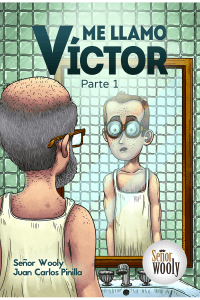
Me Llamo Victor Graphic Novel As you may know, the latest graphic novel from Señor Wooly is titled “Me llamo Víctor Parte 1” and is almost available. Hopefully you have pre-ordered it, as it is expected to ship in the coming weeks.

When I found out that Wooly had an advanced copy of this book, I took a page out of Federico’s playbook and decided to do something drastic…. Robé la oficina de Señor Wooly.

Robé la oficina porque TENÍA que leer esta historia.  I have been patiently waiting for this book since I appeared in the final installment of the Victor trilogy, FEO. Pero nunca me rindí.

Let me tell you, the wait was worth it! Here’s what I thought of the book:  Continue reading

Posted in FVR, reading | Tagged , , , , | 2 Comments

What students say about acquiring vocab through reading

I love asking for student feedback. So after our classes read El Escape Cubano or El Capibara Con Botas I asked for student feedback using google forms. Both of these books include many cognates, but I also wanted students to hear the correct pronunciation of the words, so we listened to the audiobooks. The main comment was that students could hear the proper pronunciation but also the tone of the reader also helped their comprehension. I’ll be interested in seeing how this affects if more students will use the audiobooks during our FVR time this year. See full student responses here.

Then I asked students  to respond to a Krashen quote with their experience. The prompt was: “Stephen Krashen says that “Picking up word meaning by reading is 10 times faster than intensive vocabulary instruction”. Respond to your experience so far in picking up words through reading.” The students responses are rather enlightening…. Continue reading

Posted in reading, TPRS, Vocabulary | Tagged , , , , | Leave a comment

Why giving “Spanish Names” in Spanish class has unintended consequences

What was once a very common practice in Spanish classrooms has now become a bit Why giving your students controversial. While many teachers are choosing to no longer give students random “Spanish names”, the practice still continues. But those that continue to give names may not realize the unintended and harmful consequences.

Continue reading

Posted in Discussion/Methodology | Tagged , , , , | 43 Comments

First Days All in TL

We just finished up our first week of school and I wanted to get this blog post posted while I still have the energy to type. For those of you who haven’t started school yet (or those who will read this blog in future summers) I wanted to share how I used the target language during 90%+ during the first week of school.

First, let me say that on the first day, I’m not looking to bore the students by going over the rules or the syllabus. I’m sure they get bored of that in every class. Instead, I look to get off to a running start and let them experience how my class works by doing a lesson right away.

Continue reading

Posted in Lesson Plans | Tagged , , , , | 9 Comments

Special Person Interviews

This is a guest post from Christy of Christy’s Classroom who tells how she incorporates the Special Person Interviews in her Spanish class.

This quarter in my middle school classes I have been incorporating special person interviews. This is a great way to get to know your students, build relationships and establish a positive class culture.

I am using the interviews and information from the interviews in a variety of ways to maximize input. Some ways I’m maximizing input beyond the interview are:

Continue reading

Posted in TPRS | Tagged , , , | Leave a comment

License to speak

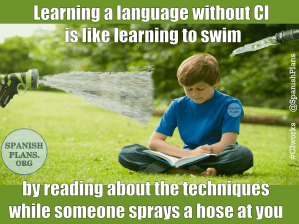
In the past we’ve used the analogy of acquiring languages as being like learning to swim. Is it best to jump in the deep end of the pool with no support? Is it practical to learn the techniques and physics of swimming before you get into the pool? Can a spray bottle simulate the same experience as being in water?

You can see our ever expanding Language Acquisition memes here.

Recently, we created this new meme with a new analogy: You don’t need to know how an engine works to drive a car. And you don’t need to understand grammar rules to speak a language.Learning Language and driving Continue reading

Posted in Discussion/Methodology | Tagged , , , | Leave a comment

Using Peardeck: a tutorial

After our Billy y Las Botas 3 lesson on making predictions using Peardeck, some teachers wanted more information about PearDeck. So here’s a brief tutorial:

If you prefer to read,  Continue reading

Posted in Web2.0 Technology | Tagged , , | 6 Comments

Previewing a Wooly Story

After months of anticipation, this week we started the third (and final) installment of the Billy y las Botas saga. I like to use a variety of strategies when telling a Wooly story, so this time we focused on making predictions. This is a great way to preview the story, as well as letting your students show their creative side and impress you with their language.

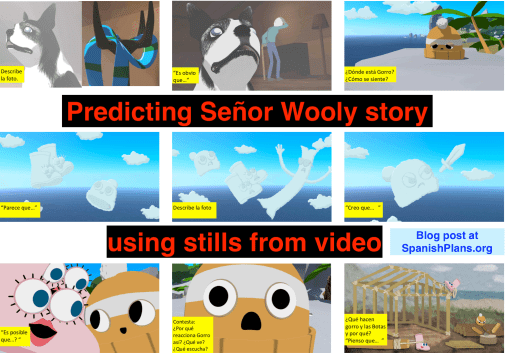
Step One: I started by pulling out 12 slides from the Powerpoint of Stills available in the extras section of every story with a SenorWooly.com Pro-subscription (if you don’t already have this, leave this post, buy it, and come back).

This activity is similar to the “Bunches of Hunches” activity combined with “A Parallel Universe” story that some of you may have used during Wooly Week 2019. Careful, not to give too much away and certainly no spoilers; you want to leave some ambiguity.
Predicting Senor Wooly story with stills from VideoStep Two: Continue reading

Posted in Lesson Plans, Storytelling, Web2.0 Technology | Tagged , , , , | 7 Comments

March Music Madness 2019

Are you ready for this year’s March Music Madness? As one of the first teacher bloggers to write about the idea of March Music Madness, we are excited about our sixth annual tournament.

This year’s bracket is as follows: Continue reading

Posted in Music | Tagged , , , , , , | 10 Comments

Leveling up

When a gamer beats a level of a game and moves on to the next level, it is called “Leveling up”. In certain games, you can increase your chances by earning more points, collecting coins, or obtaining specific weapons to help you defeat the opponent.  Gamers have their strategies on what they need to do to level up. Our students also need to know what strategies they have as language students so that they too can “level up” on the ACTFL proficiency levels. Does a novice student know what they need to do to work their way up to the intermediate level?

My initial inspiration for this post started many months ago when I saw a tweet by Bethanie Drew (@lovemysummer) when she posted a link to her blog with placemats for “Weekend Chats“. In her document, she included this:
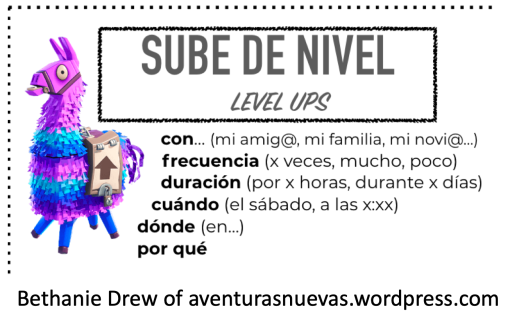
levelupsbybethaniedrew

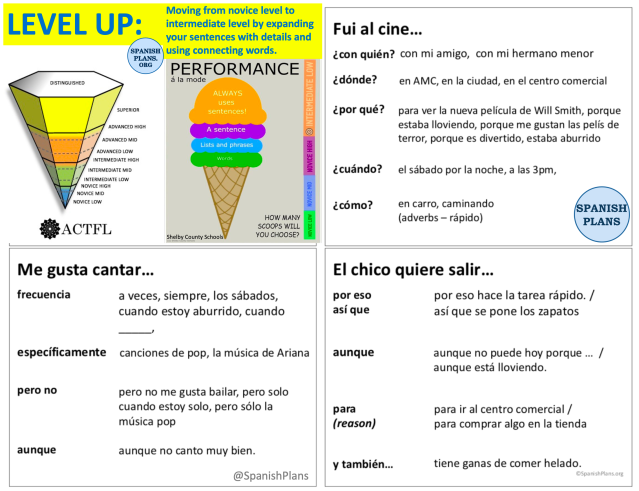
This encouraged students who were ready to add to their simple sentence by adding more details. I realized that students don’t know how to level up their language. In order to show higher proficiency, students must realize what that looks like. A few months into the school year, I went over the ACTFL proficiency ratings and its cone shape and that the more input a student has the more advanced their language will be. Then we went over this presentation.
levelingupinworldlanguages
Then I gave students sample sentences and had them work with partners to come up with the extra details.
You can purchase a copy of the presentation perfect for helping students understand how they can move beyond a novice level performance. The download also both a Spanish presentation as well as an English only example presentation that can be used for any world language class.
You can save when you purchase it with our highly rated Proficiency Level posters in this super-save BUNDLE.

Take a look at how the following sentences were “leveled-up”:
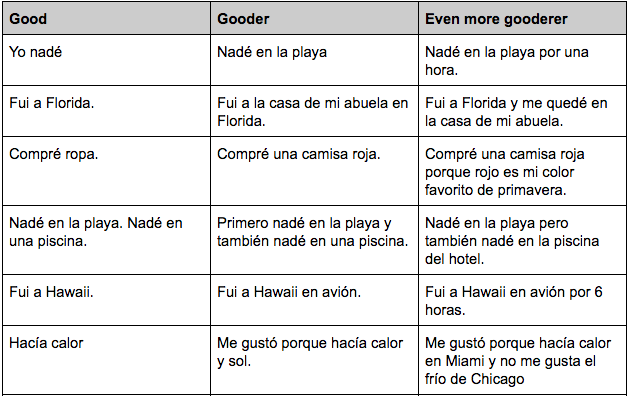
Another way to talk about proficiency is to use the ice cream cone imagery, to encourage students to “Add an extra scoop” of language. See our previous post “Get a scoop of proficiency” which includes a  download of posters explaining the different proficiency levels.

When I have students write about their weekends, using the Weekend Chat cheat sheet, I get many students just copying down a phrase. And that is perfect!! It’s a novice low skill. As the year progresses, I want to push the students who are ready to try to move beyond that. But many don’t know how, so I give them the following example:
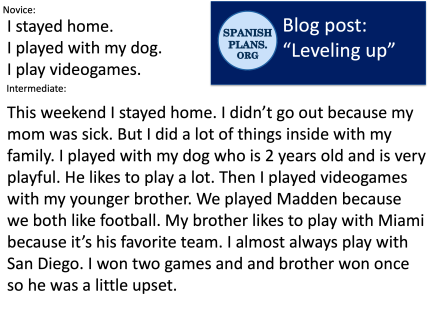
Novice to Intermediate Leveling up

Leave it to Bethanie, who also would go on to blog about this later as well. Look at her strategy to encourage better writing in her students, in her blog post “Level Up Language Framework (Structures to support student learning and teacher sanity, part 6)

Posted in Discussion/Methodology, Free | Tagged , , | 8 Comments