Collaboration

Thanks to the internet, you are never a department of one. The free exchange of ideas and collaboration is rampant on the web, with such social networks as Twitter (#langchat) and Facebook (Spanish Teacher Groups).

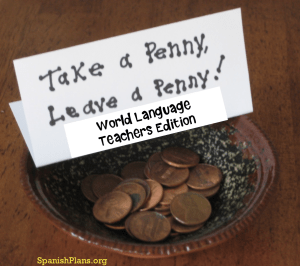
Google Drive has allowed teachers to create databases of amazing resources. Check them out. Consider it like the old penny tray: Leave one, take one. While we all benefit from the vast resources that are currently available, we would benefit even more if every teacher who used a resources also left one of their own.Take a Penny World Language Teachers
General Databases:

MovieTalk Database: In search of a video to use as a movietalk? Want to target specific structures? As of right now, they are 180 entries (and growing). Will you be the one to make it 181?

MovieTalk Database 2: Another list of nearly 100 videos.

Authentic Resources Database: The bottom tab separates the languages, and each page features links to an authentic resource along with an activity.

Target Structures Database: Structures for multiple languages along with ready to use lesson plans.

Transcription Databases:

Spanish Commercials: Find a comercial on youtube

Spanish Recipe Tutorials:  Using cooking tutorials from youtube, students can complete cloze activities and rewrite the recipe in their own steps

If you have other databases to share, please add them in the comments and we will add them to this post. If you’ve got an idea for one, start your own!

A shout out to Martina Bex, whose “Eight Days of Hanukkah” encouraged many teachers to add to these database.

 

Posted in Authentic Resource | Tagged , , | Leave a comment

Authentic Resources for Recetas

If you are looking for some comprehensible input for your food unit using authentic resources, then we’ve got something for you.

We’ve transcribed a few authentic cooking tutorials in Spanish from youtube that you can use as listening or interpretive reading activities with your students. Students then will re-write the steps to the recipe using their own vocabulary. If at novice level, scaffold the tasks with the students, and have them write very basic steps of the recipe. An intermediate student can write more detailed steps.


Spanish Recipe AuthResCheck out our Recipes Cloze that includes 4 cloze activities along with a template for students to rewrite the recipe, such as how to make: Continue reading

Posted in Authentic Resource, Lesson Plans | Tagged , , , , , | Leave a comment

Fotografia by Juanes Embedded Readings

In this post we shared with you our Storytelling lesson related to the Juanes song Fotografia. This story features the structures busca, llama, and está/ no está. You can download FREE Fotografia story or you can buy our editable version which also includes a storyboard.

La Historia de Fotografia

Fellow Spanish teacher, Zachary Bryant, (@bryantz83) took our lesson and adapted it into the following embedded readings. Here they are: Continue reading

Posted in Storytelling | Tagged , , , , | 1 Comment

Alma MovieTalk lesson

My first MovieTalk and I loved it. I used the short animation, Alma, with my first year students and it went great. We were able to use the movie to practice so much language:
1) structures of quiere, puede, mira, ve, busca
2) review clothing vocab, review preposition, review some emotions and learn a few new ones

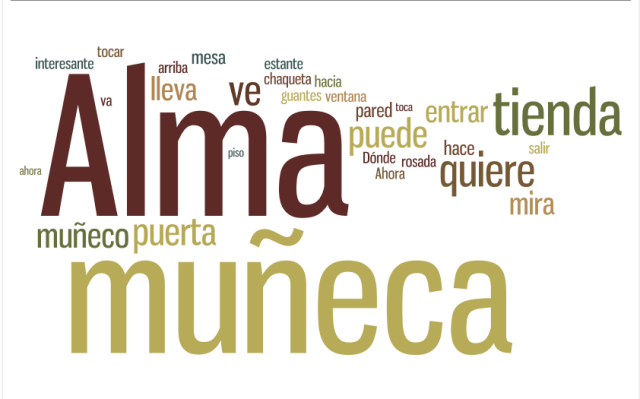
Alma wordle

Use wordle to check the frequency of the structures in your story

You can use this with any class/level and focus on any aspect of the language appropriate to your students.

Here’s what I did in my class: Continue reading

Posted in iPads, Lesson Plans, Storytelling | Tagged , , , , , | 6 Comments

Promoting Performance

In a performance and proficiency based classroom, students coming from traditional classroom needs some guidance. Musicuento uses an example of a “Talking about a taco” to show the different proficiency levels.

Can you use singular words to talk about a taco? Can you uses phrases? Can you use whole sentences? These are all part of performance of a language from novice low to novice high.

This year I’ve been using this image I found online from the Shelby County Schools. They also have a cute “Path To Proficiency” image as well. I used the poster maker at my school to make a large version to hang up on my wall. On performance assessments, I’ll write the quote “How many scoops will you use?” and sometimes may add a small ice cream cone clipart.

Performance Assessment Ice Cream ScoopsI like using this image to challenge my students to how many scoops they will use. We talk about the metaphor that the more scoops your ice cream cone has, the better it will be. The more language they use on their performance tasks, the more language they are showing me they can use. This also involves a bit of risk taking as well. The more scoops you stack, your cone may become a bit more wobbly, but it is worth the risk because you are going to have more ice cream. You may end up with some ice cream around your mouth as it may get a little “messy”, but it is worth it! If you are only going to use 1 scoop, it might be very stable, but not at all rewarding.
What are the sprinkles on top of the ice cream that is really going to make you happy?

I also challenge my students with a 5 point scale that I hang up in my classroom with example sentences for this “communication rubric”.

Posted in Discussion/Methodology | Tagged , , , | 2 Comments

Travel

One of our recent posts had some good quotes to use at bulletin board dealing with perspective. Here are a few quotes relating travel and gaining broader perspective on the world.

The best souvenir from traveling Continue reading

Posted in Culture | Tagged , , | 1 Comment

Adding a little perspective

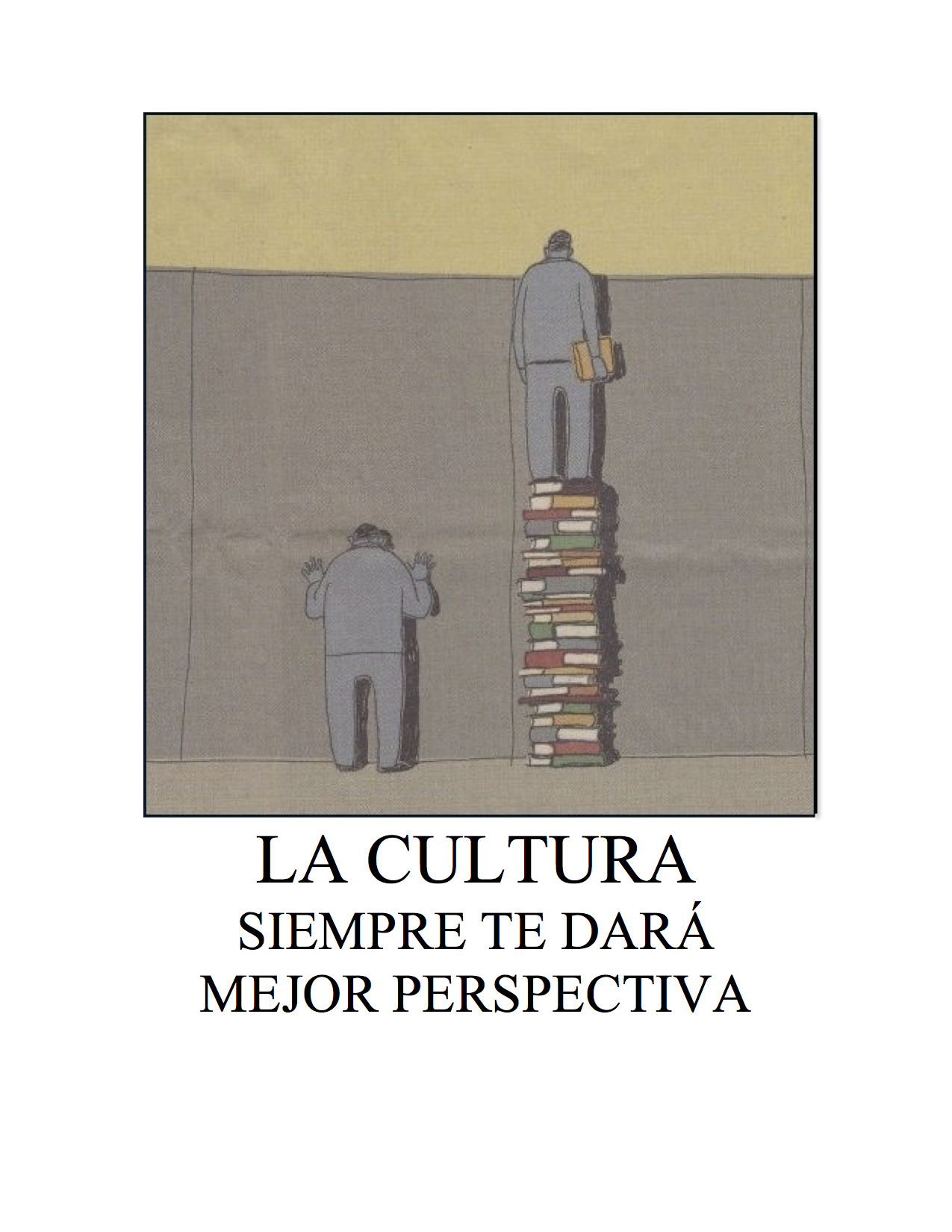
To piggyback off one of our earlier posts where we talk about the importance of Perspective in World Language, we wanted to post our perspective images that make up our Perspective Wall to display in your classroom.
LA CULTURA Continue reading

Posted in Bulletin Boards | Tagged , , | 1 Comment

Fotografia Story and Tener Que Story

We’ve just finished up 2 new stories with you and wanted to share them with you. Our first story is a story about a boy named Miguel who doesn’t like to study; he wants to play video games. But when he has to talk to the principal he learns a fun way to study that is just like a videogame…

Tener Que Lesson Continue reading

Posted in Free, Lesson Plans, Storytelling | Tagged , , , , , , | 4 Comments

Bell Work in Spanish Class

Here’s why I love Bell Ringers in my Spanish class:
1) It gets the student working as soon as the come in the room.
2) It’s a great way to get students to use their notes and practice using the language.
3) It allows the teacher a few minutes to do things such as attendance or check in with students.
4) It serves as a solid routine to start the class.

My bell work, which I call Entradas, are a good to teach students to reference their notes. At the beginning of the year, a lot of students look at the question and when they don’t know a word, they just stop. I have to constantly remind them to look in their notes. When we are going over the answers and a student doesn’t know an answer, I make them look back in their notes to find each word until they understand the question.

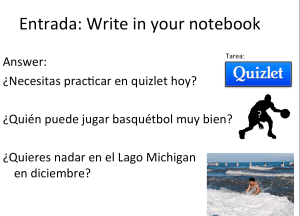
This week our focus was on the verbs: Can, Want, and Need:

Spanish class starters   Spanish Bell work

Spanish Bell Ringers     Entrada para la clase de español

On the first day, it took students a little longer to answer the questions, but by the end of the week, they didn’t need to rely on their notebooks so much and could answer the questions rather quickly.

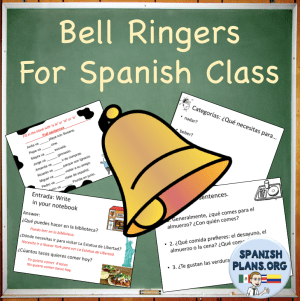
We’ve got a powerpoint recently updated with over 100 Bell Ringers ready to use.
Spanish Bell WorkIf you already own this product, download the update for no additional costs.

Another idea that we’ve recently implemented is from The Creative Language Classroom, “Let them Welcome Each Other to Class“. Each week one student from each class isAssign a profe in each class selected as “Profe de la semana”. After we go over our bell work, the profe gets to ask the typical daily questions, such as ¿Qué día es hoy? ¿Qué hora es? ¿Cuál es la fecha de hoy? and other questions related to the particular unit. Students are excited to answer questions asked by the new “teacher” and I’m more than happy to sit back and enjoy the break from asking these questions every day!

Here’s an example of a few we’ve got ready for the first few weeks of Level 1: Eres el profesor.pptx Free download

Posted in Lesson Plans | Tagged , , | Leave a comment

Resources for Hispanic Heritage Month

Did you know there are over 70 National Holidays in Latin America? Did you also know that the most popular one that is taught in schools isn’t even a National Holiday? I’m talking about 5 de Mayo, which is not a federal Mexican holiday (it’s a regional holiday celebrated in Puebla). If you are looking for ways to bring more culture into your classroom, check out our calendar of Hispanic Holidays. This free calendar can be embedded to your class website or to your own calendar to remind you of important days, or you can print a list of the holidays listed by month. Continue reading

Posted in Culture | Tagged , , , , | 1 Comment