1st semester Spanish

These are the stories that I’ve used in my first semester 8th grade Spanish class (Level 1).
spanish-1-curriculum-stories

Wildebeest Movietalk: Hay, Dice, Ve. Martina Bex has this great Embedded Reading/Movietalk which is a perfect thing to start the year. This lesson you can download for free.

To go along with the video, I teach other common animals and we watch the video el lavacaPollito Pio.
I then read them the book La vaca que dice Oink, (preview here) which we use to talk about the benefits of being bilingual. Through the story, it is totally comprehensible and gets in the rep of dice. You can also use this video as  MovieTalk about a pez that says Gua Gua.
I also used the book “Oso pardo, oso pardo, que ves ahi”.

Va a Mexico TPRS StoryThe next story was Va a Mexico that focuses on the strucures Va a, Tiene, y Está en. I use this story after students put together their class passport.

To go along with the structures of “va a” we listened to the video Continue reading

Posted in Storytelling | Tagged , , , | Leave a comment

Soy Yo by Bomba Estereo

soy-yo-movietalkI’m sure by now you’ve heard about this song and video. If not, you’re gonna love it. Here’s how I recently used it in my class:

1. Students work on “Soy Yo” packet by Kara Jacobs. I used 5 pages: the vocab page, the paragraphs where students write out the Spanish word by pulling the vocabulary from the paragraph, the full story (circle the answer), and the Imaginemos page.

I actually used this as a sub plan and it took a majority of my students almost the entire 40 minute class period.

2. Students watch the video. Hopefully you have youtube unblocked at your school and have access to technology so students can do this at their own time. Otherwise, you will have to show them the video to the whole class.

3. For students who finish early, you can have them practice the vocabulary on Quizlet.

4. The next day, I have students complete an Edpuzzle activity. If you have never used edpuzzle, you will Continue reading

Posted in Storytelling | Tagged , , , , , , | 7 Comments

Buzz Reading

buzz-readingI use this technique to practice reading. It may involve a lot of re-reading, great for extra repetitions, but the students enjoy its game aspect. I call it Buzz Reading, but other names include Bell Reading. All you need is a traditional classroom bell or find a buzz maker sound on youtube.
Here’s what you need:

  1. A copy of a text for each student.
  2. Number the paragraphs on the reading.
  3. Explain in the target language that each student has to read one sentence and then the student next to them must continue. If there is a pause between the two people, the teacher rings the bell and the second person would have to start reading the story from the very beginning.
  4. Also, if a student read more than one sentence, the bell is rang , and that student had to start at the beginning of the story.

Continue reading

Posted in reading, Storytelling, TPRS | Tagged , , , , | Leave a comment

Redefining Boot Verbs with CI

We’ve all heard of “boot verbs” to teach the conjugations forms of stem-changing verbs.
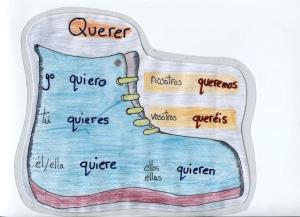
Take the i–>ie stem changing verb querer:

boot-verbs
Cute, right? Well, sure….If you want your students to only be able to memorize verb forms without actually acquiring them or being able to use them in context.

At the Comprehensible Midwest Conference, Dr. Krashen delivered the keynote. As CI teacher knows, teaching verb conjugations as a way to acquire the language would not fall under the umbrella of teaching with CI. If we are using grammar concepts to teach the language, our students are probably not acquiring the language. “When your hidden agenda is the future tense it’s hard to make class interesting” – Steven Krashen.

The key is to make language compelling and personalized (and comprehensible obviously). He used the analogy of eating a well-balanced diet. In your diet, you don’t think to yourself, “well, I need to take some vitamin A now, and then later I better take a dose of protein.” If you have a well balanced diet, your vitamins and nutrients will be present in your food. Your nutrition is not sheltered. Well, grammar is the same. We do not need to have a lesson on boot verbs. Stem changing verbs by themselves should not be the focus of a lesson. Boot verbs should be part of the input we give to our students. Over time, they will acquire all the necessary structures they need to be able to use them in their communication.

With that being said, I’d like to redefine what a boot verb is. A boot verb should be a verb that you can use when talking about boots. What type of structures are compelling to students to talk about boots?
These are MY boot verbs:
Redefining Boot Verbs as a CI teacherMy boot verbs include Se pone, tiene, quiere, va, and necesita. I can use these verbs to talk about boots. What are your boot verbs. Share them on twitter with #MyBootVerbs or leave them in the comments. Give us a sentence talking about boots.

chanclaWhat about Flip Flop verbs? Continue reading

Posted in Discussion/Methodology | Tagged , | 1 Comment

Get a scoop of Proficiency

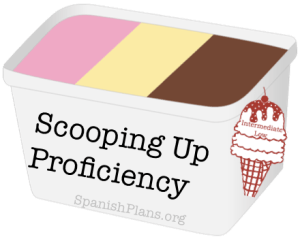
Since adopting an ice cream metaphor to talk about  performance and A blog post about using the metaphor of Ice cream to talk about proficiency in the world language classroom.proficiency with my students, my favorite phrase to encourage students on assessments or when they are writing is:  “SCOOP IT UP!” 

To go along with this theme, we have created these proficiency level posters that teachers can’t stop raving about.  It’s an easy way for students to see the difference between novice levels and intermediate level-type performance. Teachers have been making bulletin boards and are loving the visual that makes ACTFL’s proficiency levels kid friendly.

Continue reading

Posted in Discussion/Methodology | Tagged , , | 4 Comments

Spanish from Day 1

The first day of Spanish class. You want to be welcoming, you want the students to feel comfortable. You also want to set the expectation that this class is different. You want to maintain 90% of the class in the target language. It can be done. Here’ a few ideas.

One of the first things I do while taking attendance is establish the name students call me. After I say the students name, I prompt them to say “Hola, profe” or “Sí, profe”. If they say “Sí”, I will prompt them with what I want them to say. I make sure that they repeat it. I do this for the first several days. Sometimes I will just say a students’ name and look/nod at them and wait to them to say “Sí, profe”.

I then give the students an introduction of myself. I talk about where I am from, my family, my background in teaching and traveling, and my hobbies. During this period of time, I am speaking as if I am talking to a native speaker. I do not use visuals, I do not restate in simple terms/vocabulary. I do not give processing time. I then ask students what they understood. The response is usually not little if anything. Then, in Spanish, I explain that I am going to do it again, but this time differently.

I use this PowerPoint Template (you can download for free and input your own information). This time, I use visuals from the Powerpoint. I explain it in simple terms. I give processing time. I speak at a slower rate. I check the audience for understanding. I do everything I can to make it comprehensible.

TL from day 1Then I ask students to tell me what they understood. This time, they can tell me everything! I then ask them (in English) why they understood more the second time. I explain to them that I will be speaking to them in Spanish, BUT that it is my job to make it comprehensible to them. Their job is to be active listeners, because watching my gestures or visuals is important to their understanding. This helps them feel comfortable and not be so overwhelmed that I am just going to be rambling in Spanish.

On the second day, I like to do some sort of TASK that students have to accomplish. They have to listen to the instructions and follow along with what I am modeling. At the end of the class, I ask them if they were able to accomplish the task? When they say yes, I remind them that they were successful in accomplishing something and they didn’t need English to do it. One example is to have them set up their notebook, or you can have them create a passport booklet.


Posted in Lesson Plans | Tagged , , , | 3 Comments

What’s the Acronym for Acquisition?

We’ve all heard them. Most of us have probably even used them at one point or another. I’m talking about those cute little songs and acronyms to memorize grammar rules, irregular forms, verbs, and more.

commands irregularsExample: Your students are learning about command forms. So, you give them this little trick (on right) to remember the irregular forms for positive tú commands: Ven Di Sal Haz Ten Ve Pon Sé.
Easy Peasy. Your students are going to rock out on the commands quiz.


verbos irregulares preterito
Or how about using the tune of “Twinkle Twinkle Little Star” to memorize the irregular yo form verbs in the preterite. Sing that little tune during the quiz, and you’ll be set!

Then there are all the acronyms to remember the difference between Ser and Estar (Doctor Place), when to use the subjunctive (WEIRDO), and I’m sure they are many many more examples.


These tools may be great help to pass a quiz. But are they really that useful when it comes to acquiring a language? Continue reading

Posted in Discussion/Methodology | Tagged | 11 Comments

Making your own CI movies

After my class finished reading the TPRS Publishing novel Esperanza and were working on their final projects, I spent some time playing around with an iPad and ended up making a video for chapter 1.
The most useful aid in comprehension for my own students had been the Audio Book that we listened to as students followed along in their books. This was my first time Making Movies for CIusing the book and perhaps there were a few parts that I could have done a better job in making sure all students had full comprehension of the events in the chapter. One way to aid in comprehension is to make your own “movie” of the events of the book.  You can also use this technique for ANY story you tell in class and we are going to tell you how. Continue reading

Posted in iPads, Projects, Storytelling | Tagged , , | 1 Comment

Appropriation in Education

I’m glad to see many people responding to our #MasQueSombreros /#MoreThanSombreros challenge and enjoy the new hashtag #ReclaimCinco (on Instagram and Twitter)

As educators, we must demand the end of the appropriation of the Mexican culture. This is never more prominent than on Cinco de Mayo.

Stop with the Sombreros. Stop with the Talking Tacos. Stop the mustaches. Stop the donkeys. Stop the cactuses and maracas. Stop the appropriation of a rich culture. Let’s educate, not stereotype.

I urge our followers to help put an end to the stereotyping. We don’t need to look any further than one of the largest Spanish Teacher companies, Continue reading

Posted in Culture | Tagged , , , , , , , | Leave a comment

Videos for Esperanza

While teaching the TPRS Publishing novel, Esperanza, we watched an interview with a Honduran coyote. The coyote talks about the business of human trafficking and bribing officials along the way as well as how much the coyotes charge. We watched this at the end of chapter 9 where the parents suddenly need to bring their children to the US

Then, we watched clips from a documentary that Mike Peto shared on his blog. While we didn’t watch the actual documentary, we did watch several clips available from the documentary’s website. It shows the Tapachula Detention Center in Chiapas. We watched a portion of about 4 clips. These clips show the faces and voices of children, who are in the same situation as Ricardito and Liliana. Video Clips for Esperanza Spanish novel

We talked about how scared the kids looked and their only desire was to be with the family. It was a really eye-opening experience for my students. Seeing these kids showed them that the experiences from the book are real. Listening to “Jose’s best friend in El Salvador” nearly broke my heart when the kid said “Ya no juego mucho como jugaba antes con él” and when the interviewer asks him if he could have anything in the world that would make him happy and responds that it would be for his friend to be reunited with his mother.


Posted in Resources | Tagged , , , , | Leave a comment