
If you are a language teacher, then you know the best night of the week is Thursday evening. This is when some of the best world language teachers come together to collaborative and improve themselves as educators. You don’t even need approval from administration to attend and pay a costly registration fee. This weekly conference  is taking place on twitter, using the hashtag #langchat. A recent topic had some great discussion in regards to tips for starting a proficiency based program.
I personally started working towards a proficiency based classroom a few years ago after years of being very comfortable teaching grammar and watching my students memorize verb charts, and singing songs to remember grammar rules. But I don’t want my students to have to stop mid-sentence to sing a song to remember whether to use por or para. From reading tweets and blogs from my fellow colleagues, I decided I needed to make changes in my own classroom to help my students be able to communicate in the language.
For me, the process has been going on the past few years. Every year I learn more and am able to implement better practices into my classroom. My first start was to use more language in the classroom. An important step was letting students know my expectations for their understanding in class.
 A key change in my class was to ditch the focus on grammar and focus on the communication. For this, I “started at the end” by deciding what the goal of each unit
  was. Once I came up with these objectives, I could “work to the beginning” and start planning what input my students need and what activities I could plan to help them achieve those objectives.
 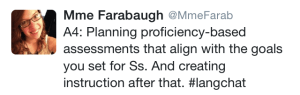 As a teacher, I aim to give my students as much input as possible before I ask them to produce something. I want to make the topic engaging and appeal to my students’ interest. The characters in the textbook certainly were not going to get my students excited about the language. But talking about the game between Barcelona and Real Madrid did. (See: Connecting Vocabulary to our Students)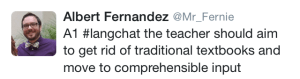

Another change I wanted to make was to have my students’ ability reflected in their grades. In the past I’ve seen students who can’t even respond to a simple question leave class with an A and students who just don’t do anything outside of class leave with low grades. I decided to focus my grades on the students’ proficiency. That means

I had to make a big change in my tests. No longer would fill in the blanks or verb conjugations punish students for errors in spelling. If the purpose of our class is to communicate I had to assess students ability to communicate and not whether they could memorize a box. (See: Ditching the Verb Chart)
Here’s some of our earlier posts about our venture toward a more proficiency based classroom.:
Communication Rubric : assessing student production, and giving students a goal to work towards when communicating.
Proficiency Based Exam: How to create a proficiency based exam using your unit’s objectives.
What students had to say about taking a proficiency based exam.
Authentic Input versus Grammar Drills: If a student can conjugate the verb “to eat” in 3 tenses, does that mean they can order food in a restaurant in the target language?



 ever, we wanted to highlight some of the posts that have not seem substantial hits, that you may have missed! Today we bring you our Top 5 “Hidden Gems” posts that may be worth taking a look at. And if you enjoy the post, please share it on pinterest, facebook, or twitter so that others may benefit and it doesn’t remain so hidden. Check out our “secret” posts.
 4. Graphic Organizers
 3. Spanish Projects
 1. Family Tree

 The 30 for 30: Soccer Stories








 SpanishPlans.org