Spanish Idioms/Proverbs

Bring the culture of the language to your classroom with these 15 easy Spanish proverbs that even students in level 1 and level 2 can figure out. While they not not be able to understand these proverbs by themselves, in this multiple choice situation, they can figure them out by using what vocab they do know and using logic to figure out the rest.

IDIOMS/PROVERBS

_____ 1. Dime con quién andas y te diré quién eres.

_____ 2. Llueve sobre mojado.

_____ 3. Levantarse con el pie izquierdo.

_____ 4. Poco a poco se va lejos.

_____ 5. Cuando el gato no está, bailan los ratones.

_____ 6. Más vale tarde que nunca.

_____ 7. No dejes para mañana lo que puedes hacer hoy.

_____ 8. Lo que el agua trae, el agua lleva.

_____ 9. En boca cerrada, no entran moscas.

_____ 10. En el país de los ciegos, el tuerto es rey.

_____ 11. Quien más tiene, más quiere.

_____ 12. El que se fue a Sevilla perdió su silla.

_____ 13. Cuesta un ojo de la cara.

_____ 14. Más ven cuatro ojos que dos.

_____ 15. Aunque el mono se vista de seda, mono se queda.

a. Get up on the wrong side of the bed
b. When it rains, it pours.
c. When the cat’s away the mice will play.
d. Better late than never.
e. It costs an arm and a leg.
f. The more you have, the more you want.
g. Slow and steady wins the race.
h. Birds of a feather flock together.
i. Finder’s keepers.
j. Don’t leave for tomorrow, what you can do today.
k. In the land of the blind, the cyclops is king.
l. Two heads are better than one.
m.  Here today, gone tomorrow.
n. A wolf in sheep’s clothing is still a wolf.
o. Better off quiet.
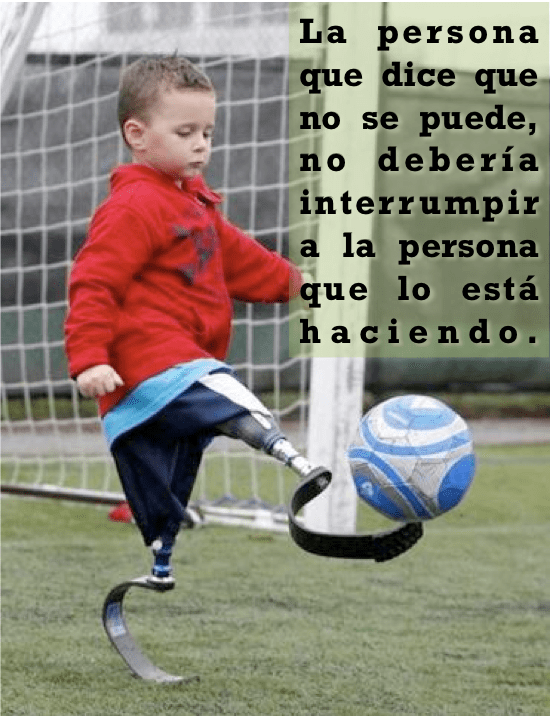
la persona que dice que no se puede no deberia interrumpir

Posted in Resources | Tagged , , | Leave a comment

Making Comics and Cartoons

It’s project time. Looking for something new and unique and something that will interest students? How about having your students create their own comic strip or comic book to showcase their knowledge in the unit. Want students to summarize a book or a passage? Want students to write a dialogue? Whatever subject you teach, you can use this lesson for any grade and any topic.

Of course, students can hand drawn their own comic by folding a piece of paper into six squares. But to really make it look professional, let’s use some technology!

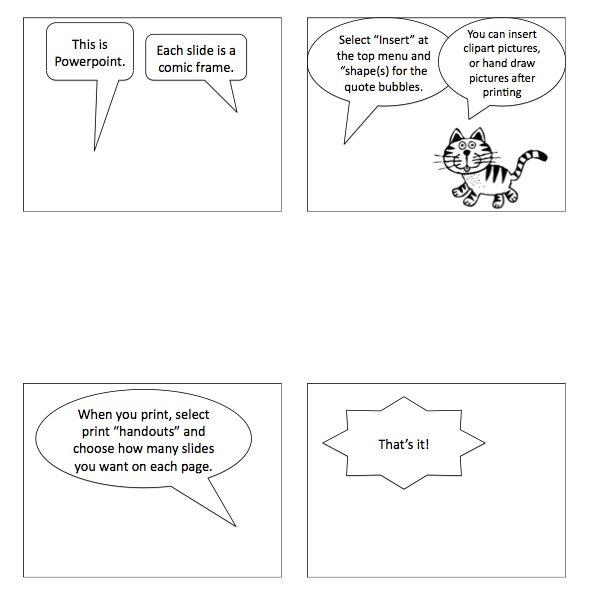
For those with limited internet access, our first suggestion is to use Microsoft Powerpoint to create a comic. Use Microsoft’s auto ‘shapes’ that look like speech bubbles, insert into each slide and away you go!

Sample Powerpoint Comic Strip

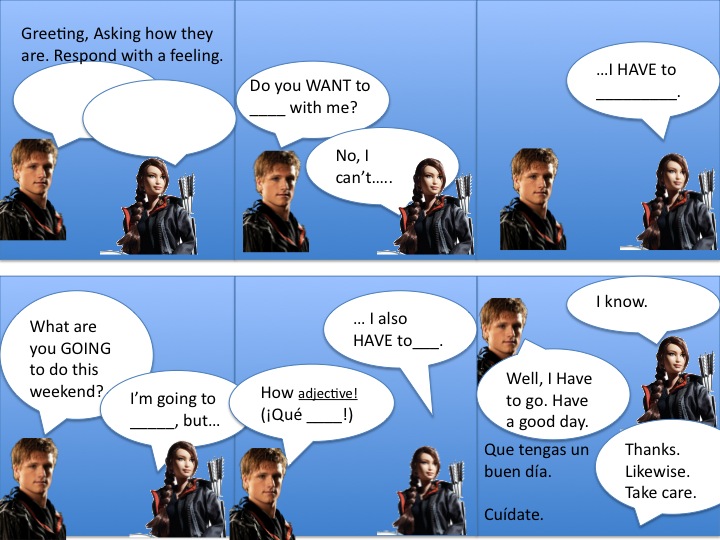
Or you can use Powerpoint to set up a sample outline of what you wants students to do:
Tener Que Comic

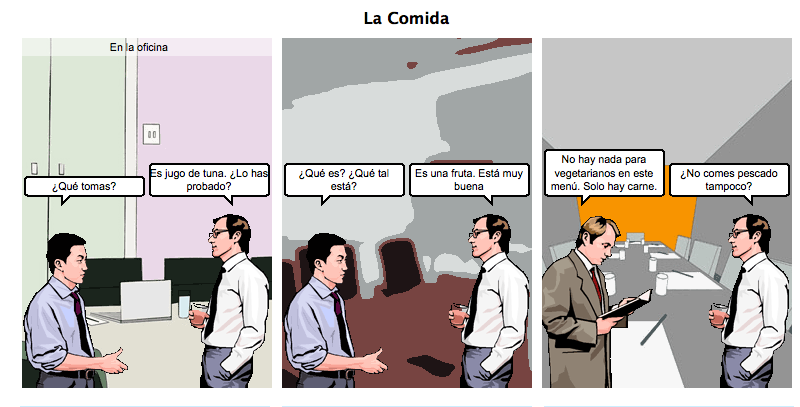
Next, is a simple website called wittycomics.com Although your background and characters are limited, it allows the students to focus on the message and dialogue rather than the visual component.

Spanishcomic

WIttyComic Comic Strip

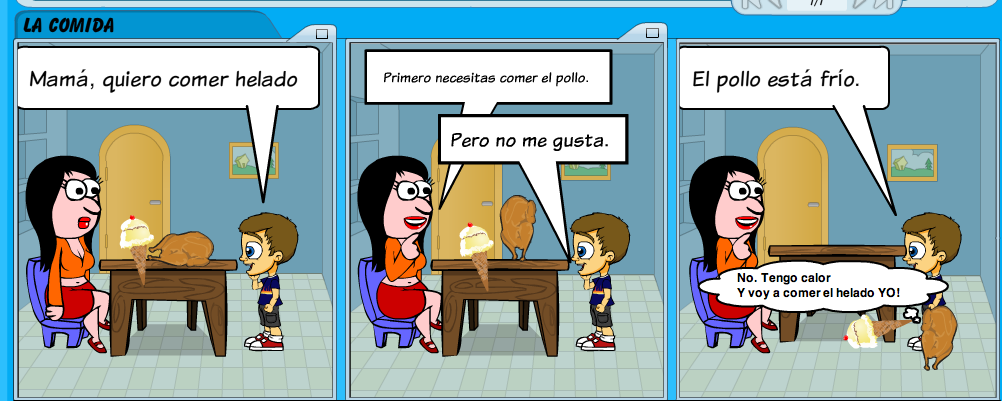
The next website, toondoo.com does require you to register a username and password with an e-mail address, but it is free. It is more advanced than the previous site and has lots of characters and props to insert into the strip.

Spanish Comic Strip

ToonDoo Comic Strip

Stripgenerator.com is another free comic strip creating website.

Another website, which looks to be very advanced is pixton.com, although this site is not free.
You may also want to ask your tech people if your computers are equipped with the software program ComicLife.

Posted in Lesson Plans, Projects, Web2.0 Technology | Tagged , , , , , | 2 Comments

Musica y Videos en la Clase

In addition to playing authentic music during the first few minutes of class and during work time, I try to incorporate fun and interesting music and videos.

Maybe some of you have seen these before, or even used them yourselves. If not, take a look:

(Note: If your school blocks youtube, try teachertube.com . Another thing to do is to save the youtube video to a movie file. All you need to do is have the youtube link/url. There are many websites that convert urls to video files. One I consistently use is mediaconverter.org)

A high school Spanish teacher in Ohio has been a youtube senstation for Spanish classes with his parodies of Justin Timberlake songs about conjugating verb. The first, “Conjugations Back,” explains how to conjugate -AR verbs. The second, “Cry me a Verb,” focuses on irregular yo forms and stem change verbs. “Reflex your verby” is a good review of reflexive verbs too.

Next, an Illinois Middle School Spanish teacher, who goes by the name Sr. Wooly, creates his own original music to teach specific grammar or vocabulary concepts.  One of students’ favorite song is the hilarious “Puedo Ir al Baño” which also has its own video. You can purchase his original music on a CD and receive full site access to additional music videos, song lyrics, and more.  I also believe his songs are also available on iTunes.

My next set of videos recommendations are from youtube and I have used in class during specific topics.

During the teaching of prepositions of location, these Sesame Street (Plazo Sesamo) videos are a flashback to your students childhood memories. If you are interested in taking a look at Plazo Sesamo youtube clips, I recommend starting with user MarshalArchibaldo, who posts a variety of Spanish Sesame Street clips and is always adding more.

First, is a Monsterpiece Theatre piece by Cookie Monster (in Spanish, his name is Lucas. Grover=Archibaldo, Kermit=Rene, Bert & Ernie= Beto y Enrique)
Monstro dentro de una caja – Monster inside a box with Cookie Monster
Arriba y Abajo – Up and Down with Kermit and Grover
Arriba, Abajo, Alrededor, através – Up, Down, Around and Through with Grover
Arriba Abajo Cancion – by Two monsters

Next, to teach hygiene and health, I go to the Univision’s children’s program los Solecitos and use their 30 second Public Service Announcement commercials with catchy songs.

Sr. Cepillo – My kids LOVE this song, and I’ve even made a prop toothbrush out of a meter stick and some construction paper for the bristles to make my own “Señor Cepillo”
Ejercicio Fisico
Lavate las manos
Equipo Protector
Click, Click, Click – sobre el cinturon de seguridad

Any other videos you use in your classes? Share them below!

Posted in Music, Resources | Tagged , , , , | 1 Comment

15 Spanish 1 Projects

Group Projects, Individual Projects, Projects for the Main Themes of all Spanish I textbooks (Expresate, Realidades, Avancemos, etc.)

24 pages. A Majority of the projects include rubrics for easy grading and clear expectations.

http://www.teacherspayteachers.com/Product/15-Spanish-1-Projects
1. Vocabulary Project: can be used with any vocab unit
2. Animal Description:
3. School Project:
4. Food Project:
5. Menu Project:
6. Family Album Project:
7. House Project:
8. Body Part Project:
9. Commands Project:
10. Doctor Skit:
11. Daily Routine Skit:
12. Clothing Project:
13. Advice Project:
14. Past Tense Project:
15. Country Research Project:

Posted in Projects, Resources | Tagged | Leave a comment

Adivina Quien Guess Who Spanish game

I know many teachers would love to play the game Guess Who in Spanish to practice descriptions in their early level classes. Teacher’s Catalogue’s offer the game Guess Who or the Spanish vesion Adivina Quién for $25-35 dollars. I don’t know any teacher who could afford to pay that price to stock a class set.

Guess Who game

Why pay $35, when you can get it for $1.

However, if you are a garage-sale scavenger, you can usually pick up a used game for between 50 cents and a 2 dollars. (Who needs the Spanish version, anyway? It’s just a different box) Or hit up your local Goodwill store to look for the same deals. Another idea, if you have a color copier or printer, take the faces from an actual gameboard, place them face down on a copier or scanner, and print off a class set, laminate them, and you can have students use dry-erase markers to “X” off the people.

Now, that you’ve got your class set of 10 games, what’s the easiest way to ensure your students use their Spanish vocabulary to play the game? This cheat sheet allows students to make sure they are using the correct vocabulary. Best of all, it doesn’t feature any English. Using pictures, students associate the Spanish words with the actual meaning.

Guess Who Cheat Sheet SpanishReady to print! Print as many pages as you need, laminate and use over and over again. You can’t beat the price for its value! Print as many as you need, you won’t find this value in any teacher’s catalog.

http://www.teacherspayteachers.com/Product/Guess-Who-Game-Clue-sheet-for-students

Posted in Games, Lesson Plans | Tagged , , , , | 2 Comments

Ser and Estar Resources

To be or not to beSer and Estar Worksheets, Lessons, Resources

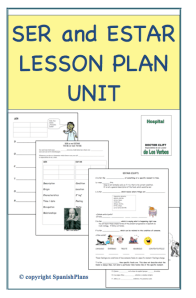
Ser and Estar Unit Lesson Plan Packet: Spanish (19 pages)

  • One of our BEST SELLERS:Ser Estar Unit
    Teaching Ser and Estar (level I and II) through a 19 page document. Included are an ID badge, 7 page guided notes packet, over four pages of worksheets, and a quiz. Answers to guided notes included. This is a PDF and not editable. Explains specific uses of each verb and how meaning can change if the verb is switched (Estoy aburrido vs. Soy aburrido)

Ser and Estar Unit Lesson Plan Packet: Spanish (19 pages) Editable

  • This is a Microsoft Word File: for a few dollars more, have the ability to edit and modify vocabulary and sentences so they fit your chapter’s current theme.

Ser Estar Practice Review Powerpoint Whiteboards

  • 36 slides for Ser Estar. Each slide features a sentence missing the form of ser or estar. Click for answer to appear. Great review for day before quiz or test. Great activity for students to quick assessment as students can write their answers on individual whiteboards.

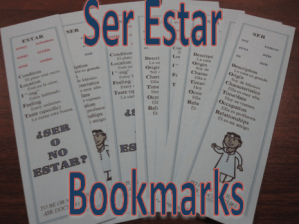
Ser Estar study sheet cheat sheet BOOKMARKSSer Estar Study Guide Print your own

  • Print off your own bookmarks to give to students for them to use during the Ser and Estar Unit. Two page document so you can print the front and back of the bookmark.
    It works best if you print on cardstock paper (only a few dollars at your local office supply store) so they are nice and sturdy. Otherwise, print on colored paper and then laminate.  Each page you print will produce 5 bookmarks. Cut along the line marked at the top and bottom of the first page.  Great resource for students to complete their homework. You can reprint a set every year to give to every student! Great value!


Posted in Ser Estar | Tagged , , , , , , | 1 Comment

Spanish and Co-curriculum

In my school the Language Arts department teaches Latin and Greek stems to their students. The students are given about 10 new words a week and tested weekly on their cumulative stems.

As their beginning level 1 Spanish teacher, I have been trying to have the students make connections with their stems and their Spanish vocabulary. It is extremely awesome to hear a student say “Oh, I know that word. That comes from the stem ______.” If students can make these connections, it will help them in both their classes.

I have created a chart of stems that they have learned, their meaning, and a related Spanish word. As we get to new Spanish vocabulary, I add new stems to the list.

Posted in Bulletin Boards, Cognates | Tagged , , , , | 2 Comments

Spanish Speaking Activities

The whole point of learning a foreign language is to be able to communicate. Our students need to be practicing speaking as often in possible in Spanish classes.

During certain activities our goal may be very specific. Sometimes we want to focus on pronunciation, so that our students sound authentic when they speak. If a native speaker can’t understand the message, because of a difficult accent in pronunciation, then there is a communication breakdown. Especially in Spanish, where pronunciation is so easy because letter sounds are so consistent, it is important to have our students speaking clearly.

Other times, we should focus on the message, and try not to get students all worked up over grammatical correctness. As long as they are able to express themselves enough so that a native speaker would be able to understand them, then communication exists. Sure, fluency is important, with the nuances of adjective agreement, correct verb structure, and so forth, but ultimately the goal is communication.

Here are 8 Spanish Speaking activities to use in your classroom:

Chores Vocabulary student oral activity Spanish

  • 20 questions for students to ask each other regarding chores and what they have to do around the house. Students ask the question orally and write down the names of their classmates according to their responses. (FREE)

Spanish Conversation Cards – Oral Speaking Activity

  • Get your beginning Spanish students speaking! Over 168 questions for your students to speaking spanish activityask and respond to. Cards to be printed measure 2.75 x 3.8 inches. Divided into 8 topics covered in Spanish I and into Spanish II. Makes a great way to practice in Spanish 1 and works as a great review for Spanish 2.

Spanish Food Oral Partner Speaking Listening Activity Comida

  • Uses a real life situation that students could find themselves in in the future where they must follow someone’s directions in Spanish. Students listen to their partner tell them which person wants what food items and they must look through the pictures and place the food in the appropriate space.

How to Use GarageBand for pronunciation assessments

  • This FREE HOW TO pdf shows you how to make a voice recording on a Mac computer using the Program GARAGEBAND. You can use this program in multiple class and across any grade level to assess students. I personally use this in foreign language to have my students record themselves and then I can assess their pronunciation. It’s the closest to a Language Lab as I can get!

Pronunciation Assessment / Oral Speaking Test for Spanish

  • Pronunciation Assessment or Oral Speaking Test for Spanish with RUBRIC included. You can use the rubric for any foreign language class. Microsoft Word file so that you can edit the reading or the rubric to your own needs. One paragraph for reading and 9 other sentences for reading. Or use your own scripts/passages because this item also includes teacher notes and ideas on when and how to do Speaking Tests, (recording vs. reading to teacher)

Spanish Speaking Activities

  • Over 13 Speaking Activities to get your Spanish students talking and conversing in the language. Includes: Surveys and Questionaires to ask their classmates, questions on notecards, and 5 pre-made activities for arranging partners. View the free preview for more info on this great communicative activity!

Spanish Location words: Prepositions, preposiciones Interactive Lesson

  • An amazing interactive lesson for teaching prepositions of location words in Spanish. Includes a location song, a great trick to remember left and right, A communicative activity that engages students and Links to 2 videos that use these words. The communicative activity has 9 pictures for students to describe to their partner. The partner draws the picture according to what their partner describes to them. I have used this lesson many times when I have been observed by administration and they love it! The students also enjoy it and you will be amazed at how they can use their Spanish effectively to communicate. One of our favorites lessons.  This lesson is ready to print and use! What a time saver!

Spanish Conversation Cards Level II – Oral Speaking Activity

  • Spanish oral activitySPANISH II:  We now offer our Conversation Cards for level 2. Divided into 15 common themes and topics on over 28 pages, this activity can be used all year! Download the free preview on the link below.

Or Save when you buy them together:

Spanish Conversation Cards

Levels 1 and 2 on one CD

Speaking/Oral Activities:
Spanish Oral ActivitySpanish Speaking Level 2 Prepositions of LocationComida Speaking Activity19 page Speaking Oral Activity
and now announcing Conversations Cards for Upper Levels:
Spanish 3 4 Speaking


Or check out our Teaching Materials section of our STORE for more great lesson plans.

Posted in Speaking, Uncategorized | Tagged , , | 2 Comments

Food / Comida Vocabulario

¿Quién tiene hambre? Todos estos archivos se tratan de LA COMIDA:
Comida_Oral_Activity     ComidaMexicanaPowerpoint
Posted in Vocabulary | Leave a comment

Expresate 1 Resources

Two months ago, we featured the textbook Expresate and offered chapter quizzes and tests for chapters 2-7 in level 1.

With the success of that post, we are today OPENING UP OUR FILE CABINET.

Take what you need!

We present you with over 40 files and 10 MB of our files, worksheets, powerpoints, activities, projects, and other resources directly from the teaching of Expresate. After hours and hours of work creating these over several years, it is time to share:

Expresate Chapter 4
Files- 19 Documents,
Worksheets

Expresate Chapter 5
Files- 20 Documents,
Worksheets

Expresate Chapter 6
Food Vocab
Presentation

Expresate Chapter 6
Files – 10 Documents,
Worksheets

Expresate Level 1 File Pack 23 MB – Over 23 MB of files from worksheets, powerpoints, tests, assessments for Exprésate Level I. Huge savings when you buy this mega-pack.


This post will be updated as we add more!

For those that use the Expresate series, we’d love to hear your comments…. Are you happy with the textbook? How often do you use the textbook in class? Do you use the workbooks? Do you feel your have to supplement a lot? Are you considering the series during your textbook adoption or thinking of going another way?

Posted in Expresate textbook, Resources | Tagged , , , | 1 Comment