Connecting vocabulary to our students

I realized something important this week while going over our unit’s vocabulary. The vocabulary is “household chores”, part of the “House Unit”. After the initial vocab introduction, we started talking about what chores students do. I quickly realized that most of my students don’t do any chores at all. So it’s difficult to “say what chores my siblings and I have to do” and “how often” as our objectives would require.

During one oral activity when students were to walk around the room and ask their classmates questions, I had to interject to keep them in the target language. I reminded them the point of the activity was not to get every line filled with an answer, but rather to be practicing their communication. In doing so, I made a comment that left me questioning the purpose of the unit. I said “Do you really care if Johnny washes the dishes and how often he does it? No, of course not. That’s not the point. The point is to be communicating.”

But how can we expect children to want to speak in the target language if they are talking about something they have no interest in. Let’s be realistic; Nobody cares about what chores their classmates do. How engaging is talking about chores? Why are we even teaching these words?! How often is Johnny going to encounter a Spanish speaker and tell them that he rarely vacuums the floor?

Who and what are your students interested in?

Sure, eventually, in order to become fluent, knowing specific vocabulary like household chores would be useful. But if we want to keep our beginning levels students interested in the language, we have to make the learning both USEFUL and INTERESTING. You can bet that is the last time I will be teaching vocabulario de los quehaceres.

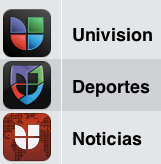
I did a quick, informal survey with my students today and asked them what activities they do at home and what topics they wanted to learn in Spanish. Some of the more popular responses were in regards to Sports, TV, Celebrities, and using the Computer. So why are we wasting our time with teaching such words like “ajedrez” and “patinar” if our students really don’t do those activities. Instead we should be teaching “mandar un texto”, “ver un video por Youtube”, “comentar en facebook” and activities that are students are interested in. Don’t just stick with the vocabulary that is in your textbook. Remember, words are not part of your curriculum. I doubt your curriculum says to teach “patinar” with “me gusta”, but rather states to “talk about likes and dislikes”, so let’s actually give students the words for the activities they really like to do.

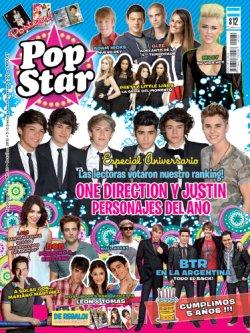
And when it comes to the textbook, do your students really want to describe a picture of some guy named “Juan” on page 25 of some textbook or would they rather describe the members of One Direction or characters from their favorite TV show or movie? We must connect with our students if we want them to connect with the language.

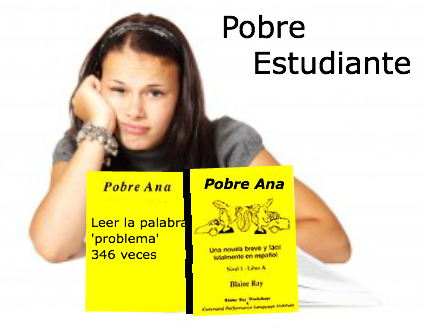
I brought in some teen magazines I had purchased in Argentina and immediately my students were interested in picking them up and looking through them. Have them read about “Pobre Ana” and ask yourself “Why would they care?”

Here are 2 teen magazines that have articles your students are going to WANT to read. You can see articles from”Tu En Linea” online.
    Tú

Posted in Discussion/Methodology, Vocabulary | Tagged , | 9 Comments

Que hora es

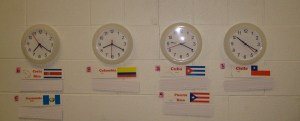
Do your students have trouble telling time? Thankfully, my school has digital clocks in each classroom and students have been able to tell me the current time. Last year, I introduced additional clocks in my room to be able to tell the time in various capitals in Latin America.

time in spanish

However, what I have noticed is Continue reading

Posted in Discussion/Methodology | Tagged | 5 Comments

Proficiency Based Exam

At the beginning of the school year we undertook a new philosophy of teaching and assessing our students. As we discussed in our Communication Rubric post, our assessments would assess what students are able to produce themselves, instead of what they couldn’t do. No longer would our tests include multiple choice, fill in the blank, or true/false statements. Instead, our tests (which we don’t even call a ‘test’ but rather an ‘assessment’) would be all production based. After 2 end-of-unit assessments this year, I am thrilled. I’ve given one writing assessment and one speaking assessment. I’ve seen kids that would typically do horrible on traditional tests do quite well on the proficiency-based assessment. They were able to tell me what they knew how to say. Was their grammar perfect? Not at all. Did they use every single vocabulary word from the unit? Nope. But were they able to communicate and be understood? YES! And I think those students should be proud of that.
To plan your own assessment, Continue reading

Posted in Discussion/Methodology | Tagged , | 4 Comments

Doll House iPad App

If your Foreign Language program has access to iPads, here is an app you need to check out. It is free and is fantastic to use during your Casa unit. It’s called Kids Doll House and it is made by Levitan Software. It is a very basic program, but it gets the job done. This app is such a great way to check for comprehension. Students describe to each other where the different furniture is in the house.

Because the house in the app does not have specific identifiable rooms such as kitchen, bedroom, bathroom, etc., students must listen to the description of the location of the room in order to place los muebles in their right place. Such an engaging and hands-on activity for students to practice house vocabulary and prepositions!

Place the furniture in the correct location

Certainly you can have students put furniture in the house and have them describe the house they created to their partners. But some students may need some good scaffolding to get to this level.

That’s why, for our own class, we created scripts for the students to read to their partners. It gives them the opportunity to read (and their partner to hear) correctly stated sentences. It’s available for purchase and saves you the time from having to create your own. Such a time saver. Check it out here.

One students read a script while another student work on the iPad.

Continue reading

Posted in iPads, Resources, Web2.0 Technology | Tagged , , , , | Leave a comment

Location Unit

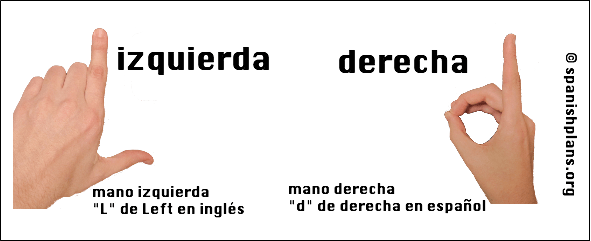
I love teaching the location unit. There are so many engaging activities to do to talk about location. I start by teaching the location words to the tune of “Pop goes the weasel”. Since many students look at their hand to see which one makes the letter L for Left, I teach them a similar trick in Spanish by having them make a letter d with their right hand, for mano derecha.

There are also some great clips from Plaza Sésamo. Continue reading

Posted in Lesson Plans, Resources | Tagged , , | Leave a comment

Edmodo Lyrics

For the past several years, I have used the song, “Nada que Perder” by Mexican rock group Maná as a cloze activity. It is a great song for seeing the structure “tener que + infinitivo

When using songs, I like to play the song a few times before giving them a worksheet so that they get a sense and feel for the song. However, most of Maná’s songs are about 5 minutes, so there is often not a lot of time. After the students fill in the missing lyrics, and write down all the infinitives I have them look up the definitions of the verbs with a dictionary, a skill many of them need to work on. I guarantee many students will write down the definition for “sonar” instead of “soñar” which gives me an opportunity to reinforce that the “ñ” is a completely different letter.

This year, I decided that I would do this activity on a half day of school. That does not give us a lot of time to look up the definitions and go over the song. So I decided to use Edmodo as a way to introduce the song to students. Here’s what they had to do: Continue reading

Posted in Music, Web2.0 Technology | Tagged | Leave a comment

Pinterest Contest

Things just got Pinteresting! Thank you to all of our followers on Pinterest…. we just hit 1,000 followers! We’d like to thank our fans by offering a free giveaway and a pinteresting contest. Details below. Those new to pinterest might want to read our post with our then-Top 10 Pins.

Continue reading

Posted in Free | Tagged | Leave a comment

Resources for LA CASA unit

Teaching a unit about La Casa? Here’s some resources for your Spanish classroom for this House unit:

Música

Dibujos
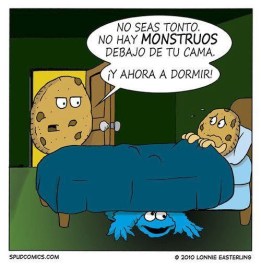
Monstruo debajo de la cama

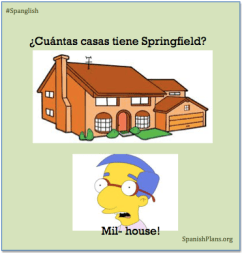
Cuantas casas tiene Springfield

See more images on the Casa Pinterest Board.

Actividades Continue reading

Posted in Lesson Plans, Resources | Tagged | Leave a comment

Hispanic Heritage Month Post 4

During Hispanic Heritage Month (September 15 – October 15) we will be posting articles

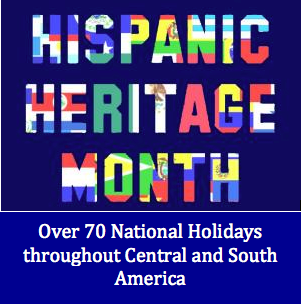
and information relating to the impact of Latinos in the United as well as looking at their culture from their home countries. The goal of this particular post is to help us realize that Hispanics have a whole lot to celebrate, with over 70 Holidays, yet Cinco de Mayo is not one of them.

Many Americans falsely assume that Cinco de Mayo is an important Mexican Holiday and that anyone that speaks Spanish must celebrate it. We have made plenty of posts that negate that (check our 5 de Mayo tag if you don’t believe us), so today we want to concentrate on the actual celebrations and holidays that take place in Latin America. Many of our students only becoming familiar with El Grito de Independencia de México and Día de los Muertos after years of Spanish classes because those are the two biggest holidays that are pushed by textbooks and marketed by publishing companies. But there are over 70 other national holidays across Central and South America. Let’s start educating ourselves about them…. or even having students research them to find out more.

To download this list on a month by month list plus a calendar to embed on your website Continue reading

Posted in Culture, History | Tagged , , , | 1 Comment

Campaña de gramatica

At the beginning of the school year we showed your our Proficiency Bulletin Board with the 4 modes of communication but our Writing section was a little blank. We’ve since found the perfect addition and wanted to share it with you.

Keep reading to download your own cute pictures of this “Campaña contra maltrato/discriminación de letras y signos”. Continue reading

Posted in Bulletin Boards, Free | Tagged | 1 Comment