
CNN Español (in English) What you need to know about 5 de mayo. My favorite line from this: “Don’t Say Happy Cinco de Mayo to a Mexican. We don’t say that.”
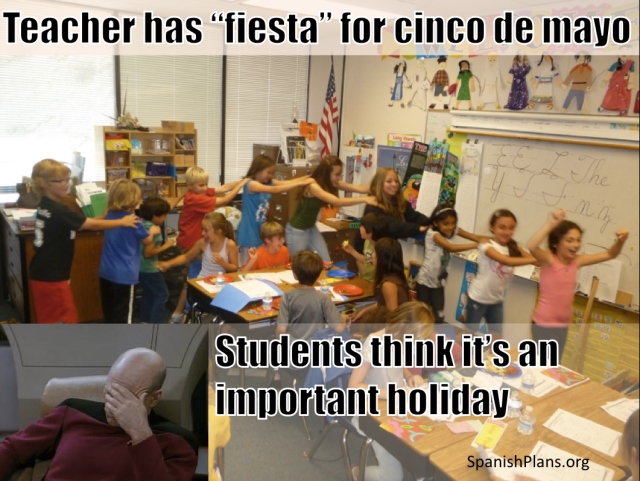
CNN Español (in English) What you need to know about 5 de mayo. My favorite line from this: “Don’t Say Happy Cinco de Mayo to a Mexican. We don’t say that.”
At the end of the year, I go around as students are cleaning out their lockers and am able to collect a lot of packs of notecards. These come in quite handy throughout the school various for various activities. Sometimes, I will use them for a quick quiz. This week, I came up with an idea after a new vocabulary lesson.
I had the students write 3 questions using their new vocabulary. Students always need practice asking questions, and this allowed them to apply their new vocabulary words. As some students worked and others finished, I was able to help correct some students’ questions.
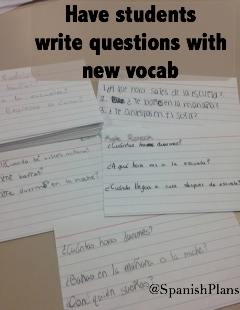
Then have all students stand up. You can ask a question to the class and have students raise their hands to answer. As each student answers a question correctly, they may sit down. This way you can be sure that every student answers a question.
Or you can direct the questions to students. Or you can have the class form two big circles, one inner and one outer and have students face each other. Have them ask each other the questions. They, rotate one of the circles until they talk to all their classmates in the other circle.
You could also collect the questions as an “exit” slip and see how well students can apply their new vocabulary.
What other strategies do you use with notecards besides having students use them as flashcards? Share below.
Ok, I’m frustrated. There is nothing more aggravating when kids just sit at their desks because they don’t understand a word. Nope, instead of bothering to look in their notes, they would rather do nothing. And you would they would realize that I’m not going to tell them the word. They know my response is going to by “Look in your notes.” and yet day after day it continues. Today, I typed up the following sign and enlarged it on our poster marker to hang it up in the classroom. It’s on bright pink paper…. they probably won’t even notice it, but at least now I can just point to it, rather them wasting more breath.
These are a list of my Top 15 Apps that I have used with iPads in my Spanish 1 class. I have divided them into 4 sections. Language Apps allows the students to practice the  language or see the language in real use. Production Apps allow the students to create a product, but by using the target language. Culture Apps allow students to explore culture and learn more about the places where the target language is spoken. Lastly, Management Apps are a way for the teacher to manage the class including turning in of assignments and posting information for the students. And best of all, all 15 of these Apps are FREE!

This app allows you to create an animated avatar that speaks. You can customize the look  of an avatar and create a background, and then you can use text-to-speech (for English text) or have students record their voice (great for foreign language class). It only allows 30 seconds of narration, so it can be used as a quick assessment or just for practice in class. This app is free on the itunes store.
I recently had my students write out their daily routines by filling in a blank 24 hour schedule for homework and then record themselves in class. With 30 seconds, many were not able to fit in their entire day, but it was the first time we used the app, so they were engaged in trying it out and it was just for practice. Check out this student example:
A good activity for students to practice new vocabulary or to check for understanding after reading is to have them arrange sentences in order. If you cut out sentence strips, this tactile activity is great for students to practice reading comprehension.

I also use these activity with song lyrics for listening practice as well. Download our free sentence strips for De Que Me Sirve La Vida by Camila.
After students have read an article, type out several sentences for the students to put in order as they happened in the story.
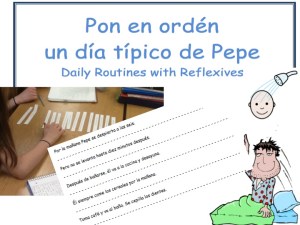
I also created this activity for students to practice reading comprehension in our daily routines unit where students had to arrange 15 sentences using such clues as time, the word depués, and linking vocabulary such as ending one sentence with “El va a la cafetería para almorzar” to the next sentence “Come mucho y ya no tiene hambre.”
Besides teaching how to communicate in a language, world language teachers also teach about culture and share our experiences from living in or visiting other countries. These stories also seem to fascinate the students. Students get to see how things work outside their own community and around the globe. Naturally, our inclination is to compare the unknown to our own experiences. However, I make sure to advise the students of their word choice. Many students question how things are done in other parts of the world and their first reaction might be: “That’s weird.”  Weird has a judgement to it. I want my students to be accepting of other cultures and understand that things are not going to be the same as in the United States, because it is not the United States. Other cultures might deem what we do as “weird”, but that is our culture. Different is a not a bad thing.
Here are some example of cultural differences that my students have found interesting. Share your stories in the comments section below and we can all learn together.
1. Do you want gloves with that?
 Stopping for lunch one day at a Colombian chicken Continue reading
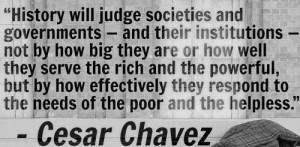
March 31 is Cesar Chavez Day.
Here are some resources to teach your students about this important American.
Youtube also has a PBS documentary “Chicano: Stuggle in the Fields.” My students already have some knowledge of the farm workers’ strike by reading the novel Esperanza Rising.
Check out tons of images including quotes related to César on Pinterest.
Or end Women’s History month with a unit about The cofounder of the NFWA, Dolores Huerta. 
César Chávez: Lucha por los trabajadores del campo por Eric Braun is a graphic novel  that teaches about this legendary American and his fight for workers’ rights in a comic book format. You can find new and used editions on Amazon or buy new from the publisher.
Capstone Press publishes other graphic novels in Spanish. You can check them out here. How engaging for your students to read about topics in a comic book format with a lot of dialogue!
Know of other resources for Cesar? Post them in the comments section below!
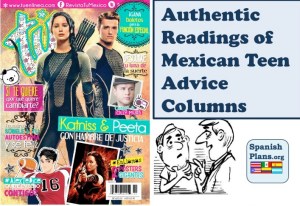
In my advice unit, I usually have kids write a letter to “Dear Abby” asking for advice. Well, when we happened upon an Advice section from the Mexican teen magazine Tú, we hit the jackpot on authentic readings. We have pulled out 7 extracts from the text and added in a vocabulary section and several questions for students to answer. This reading can be adapted for ANY level, by adapting the task you ask students to perform.
For more information on buying issues of the magazine, read our Revista Tú post. For an ready to use, adaptable powerpoint, check out our resource on TpT, (and if you buy today, get 10% off at checkout by using promo code “TPT3”. Check out all our available resources here and stock up at discounted rates)
I used to give students a handout of a graphic organizer for making the positive and negative tú commands. I would first go over the rules for making the command form and go over the irregulars with them. Then, I would give them a chart and have them write the positive and negative commands themselves.
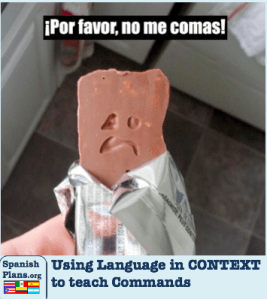
I am so glad I found a better way to engage my students and expose them to language in context. With the help of Pinterest and image search, I compiled images of commands being used in actual context! Many of the images were funny/punny: what better way to engage the students? Now, I show them the images and have them fill in the chart. So when they see these two images, they can figure out what they mean and which is a positive command and which is a negative command.









 SpanishPlans.org