Prounciation Assessment

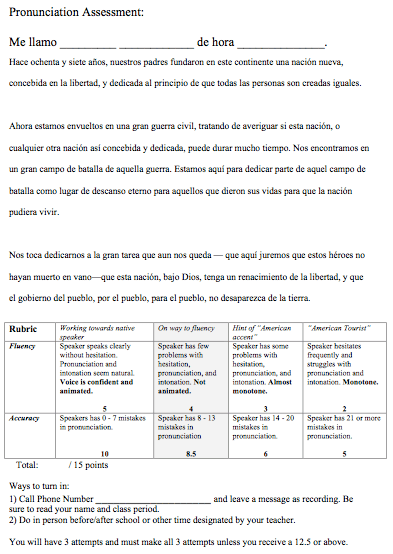
Last week, we wrote about how to get our students to improve their pronunciation. And as promised, here is our example script with sample audio by a native speaker.

We decided to take excerpts from Abraham Lincoln’s Gettysburg Address in Spanish. Students do not need to be familiar with the words in the text, because the purpose is to work on letter sounds, not comprehension. I decided to choose this particular text because many of my students also had to memorize the speech for their LA/LIT class, so I thought having this same text across curriculum areas would be a good tie-in for a students. You could also use poems or songs in Spanish.

Discurso de Gettysburg Below you can listen to the recording done by a native speaking from Colombia and Spain, respectively.

Check out the 4 steps on how to use this as an assessment.

Posted in Speaking | Tagged , , , , | Leave a comment

America is Beautiful

Who would have thought that a television advertisement for a soft drink would have such a strong message, that it would make a wonderful message of teaching tolerance? That’s just the case with this Coca Cola Super Bowl 40 commercial titled “America the Beautiful”. In the commercial, several young ladies sing a version of “America the Beautiful” in their heritage language.

The video itself is amazing, but the commentary by the young girls about the project is just as great. These young girls are able to articulate what makes America such a great nation. They have an understanding about what it means to be an American that, unfortunately, some adults don’t even have.

Watch this playlist as these girls sing the song in Spanish, Tagalog, Hindi, Senegalese-French, Hebrew, Mandarin, Arabic, and English.

After showing the original commercial, I had a discussion with my class. Many adults (and therefore children) believe that everyone in the United States needs to speak English. We must remind them that the United States has NO official language. Continue reading

Posted in Lesson Plans | Tagged , , , , | Leave a comment

Speak American

There seems to be something about sporting events and songs that honor America that brings out twignorants; people who post ignorant tweets. The last time, it was a a baseball game and a Mexican-looking person (not a real thing, by the way) which we wrote about in Land of the Free and Home of the Ignorant. Before that, it was an 11 year old American boy with brown skin and a mariachi costume singing the National Anthem at a basketball game that worked up people.

And now, it wasn’t even part of the actual sporting event, but rather a commercial during the Super Bowl.

If you are reading this, I’m sure you will think that this is an awesome commercial, and if you are a teacher like me, will probably be showing it to your classes.

Of course, that lead to many people taking to twitter with outrage and demanding that people “#SpeakAmerican“. Continue reading

Posted in Culture | Tagged , , | 1 Comment

iPad Apps for Practicing Vocabulary

Pic Collage
Pic Collage is a free app where students can create a virtual corkboard. This works as a great tool to present vocabulary. Students can import images from their camera roll, or the site has an imbedded internet search for images which is incredibly helpful.Pic Collage

utiles escolares vocabulario And you can add fun “stickers” for decoration. You can then add text. To the right is a picture posted by Jiménez es con Jota for school supplies. I created the below image for Fruit vocabulary in less than 8 minutes.App for Vocabulary Images
Skitch

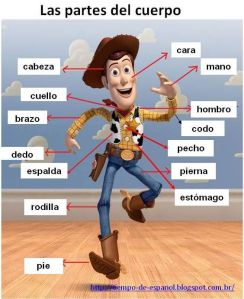
I saw this image circulating around Pinterest from Tiempo De Español and it got me thinking.body parts with cartoonsWhat a fantastic way to practice labeling vocabulary! I have my students create their own monster for body parts, but how easy would it be for students to label their own picture for any unit? For the body part unit, they could find a picture of their favorite cartoon character and in less than 5 minutes have a visually stimulating vocabulary list. You can edit photos by adding text, circling, highlighting and more with the free iPad app Skitch. This will only markup images. You need a premium account to be able to markup PDFs.

What are some of your favorite Apps to use with Vocabulary? Share them in the comments below! And come back later to SpanishPlans.org where a future post will be about using apps for communicative purposes! In the meantime, check out our other iPad resources for Spanish class.

Posted in iPads, Vocabulary | Tagged , , , , | 2 Comments

Improving Pronunciation

Improving spanish pronunciation
Using Google Voice I have made it a goal to assess my students’ pronunciation once every trimester. Students like the activity, and numerous parents have told me at conferences they love the assignment as well, and love listening to their son/daughter reading in Spanish. And it is an assessment that is designed for students to make improvements.

Here’s how to do it… Continue reading

Posted in Speaking | Tagged , , | 5 Comments

Profesor Gato

If you paws and think about what connects our students to learning, you’ll know they have to be engaged. I’m a very visual person and so I definitely enjoy a good image.  So when ICatSpanish by CatAcademy found this app, it was as fun as playing with a ball of yarn. It’s the purrfect way to engage your students. This app combines Spanish, with the king of the Internet. I am not even kitten you right meow. Students can put the paypurr and pencil  down and follow the red dot to the iphones or ipads.You can find lynks for the app and a stop to the puns below… Continue reading

Posted in iPads | Tagged , , | Leave a comment

Effective WL Instructors…

Every teacher wants to be the best they can be for their students. While there are many attributes that can make a great teacher, most important of which is giving students comprehensible input,  we can also observe some behaviors and routines that are in a great world language teacher’s classroom.

It’s good to be reminded of the actions that make a good foreign language teacher. A supervisor may use a checklist like these during an observation, you may want to self-assess your own classroom, or if you are really daring, have a student(s) check off on these.

Below you will find some rubrics we have found around the web, but first we’d like to highlight some we believe to be most essential.
Effective Foreign Language Teacher observations

Continue reading

Posted in Discussion/Methodology | Tagged , | 18 Comments

Ditching the verb chart

A great blog post from French teacher @CecileLaine on changing your teaching strategies from verb charts and grammar based teaching to comprehensible input which will lead to performance based assessments where students actually use the language to communicate. By teaching verb forms explicitly we are teaching “about the language” whereas we should be teaching “in the language”.

Authentic input versus grammar drills, a case study

I used to teach the verb “être” (to be) using a fun grammar song. We would learn the song, put all the verb forms in a verb chart, and practice, practice, practice through drills, conversations, and various writing activities. Sounds familiar? Well, these past two years I have completely changed the way I do this, and this week, rubber met the road on my proficiency philosophy.

No more verb chart, no more grammar drills

First, I ditched the verb chart. Boy I was scared, how would my students remember all the forms? Then I implemented comprehensible input and learning phrases as opposed to grammatical forms. Since the 7th grade, my students have been learning various forms of “to be” in context: we first learned to talk about ourselves so they picked up phrases such as “I am intelligent”. Then we moved on to questions and answers, so they picked up phrases such as “are you mean or nice?”. Then we talked about celebrities, family members, friends, and they picked up phrases such as “Justin Bieber is nice, Taylor Swift is nice, but The one Direction boys are awesome”. With lots and lots of input, they got most parts of the verb without ever having to put it in a verb chart. I never assessed them on what part of the verb they knew (such as a “fill in the blank” or “match subject to verb” or “conjugate this”), but rather on what they could do with the language (click here for an example of performance assessment with an emphasis on what students can do as opposed to just demonstrating grammar accuracy).

read the read of her post here.

If you are teaching verb charts and grammar, the students output will be limited. If you are using authentic input, the students will be able to produce the language.
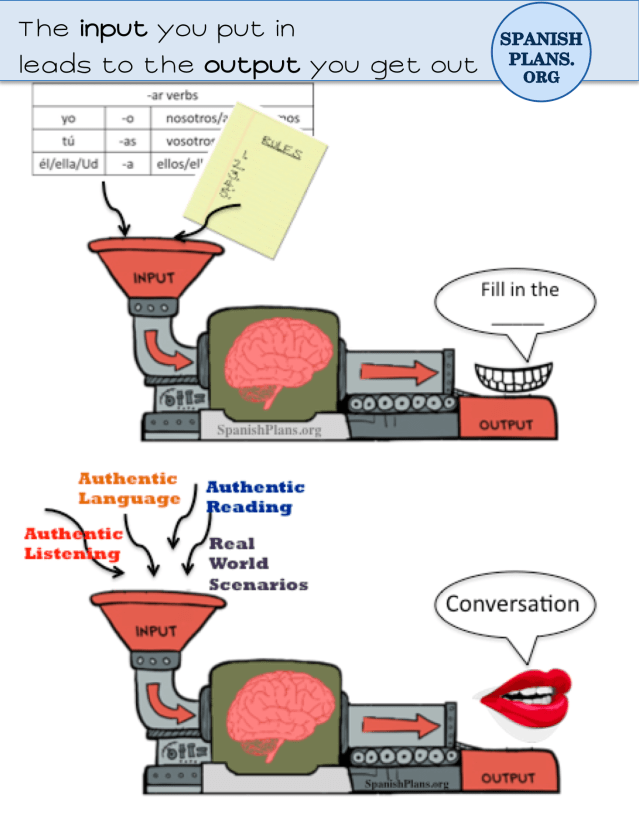
Input leads to output

For links to authentic input check out our Resources page to find input broken down by various topics.
Posted in Discussion/Methodology | Tagged , , , | Leave a comment

Top 5 Sub Plans

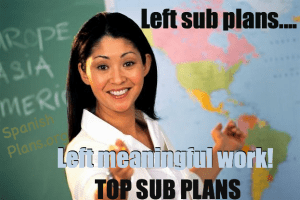
It’s that time of year…. coughing, sneezing, child puking all night. Whatever the reason, we all need a good sub plan ready to go. Here is our top 5 sub plans for Spanish teachers:
Top Sub Plans Continue reading

Posted in Lesson Plans | Tagged , , | 1 Comment

Proficiency Based Exam

After finishing our recent unit and taking the proficiency-based assessment, I gave the students a short google survey to gather some feedback. I think it is important to give students a voice in their learning and let them know you consider what they have to say.

88% of students responded that they felt their grade on the assessment matched their ability to use the language to meet the unit objectives. What students liked about the assessment:

  • I liked that we got to use as much information we knew to try and get the best grade
  • I liked that I was able to use any vocab I wanted to on the test and that there could be a variety of different answers.
  • I liked how the test gave you the opportunity to show what you know and not be limited to what was required. I could show what I knew and have my grade reflect that.
  • I liked the freedom we had to write what we wanted.
  • It actually measured knowledge.
  • How we got to fill out the speech with our own ideas, and not just translating like we did last year.
  • We got to talk about what we wanted too and it was not specific on every single word we have so say.
  • I was able to learn and use what i knew on the test. I could show you that I knew it.
  • That there was more than one answer that could be right.
  • You could write whatever you wanted to write. It didn’t tell you exactly what to write it just gave you guidelines.

Some students were comforted by having guidelines and others students wanted more freedom. Things that students “didn’t like about the assessment”.

  • You told us what to put in each box instead of us picking what we wanted in the boxes
  • That we didn’t get to choose what we got to write in the boxes
  • It also made the assessment more challenging because we had to pull ideas out of our brain randomly.

La Ropa De Compras Test

For additional proficiency based exams, check out our catalog’s proficiency section.

Posted in Discussion/Methodology | Tagged , | 3 Comments