Some teacher tips for using Google Classroom during “Remote learning” Continue reading

-
Search our site:
-
Join 1,151 other subscribers


Top Posts
World Language SLO
SpanishPlans on Facebook
Spanish Lessons
Some teacher tips for using Google Classroom during “Remote learning” Continue reading
The following is a guest post that I invited Rich Madel to write after he mentioned this activity on twitter.
All world language teachers focused on providing rich, compelling, and comprehensible input to their students know the struggle: How can we mask the repetition of the same 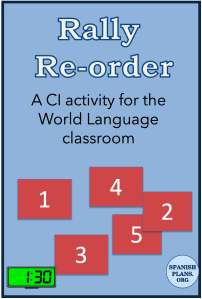 information, vocabulary, and structures in such a way that it seems novel and interesting and our students feel authentically compelled to engage with making meaning of the input?
We all know the value of repetition of vocabulary and structures embedded in strategies such as PQA (personalized questions and answers), TPRS, Movie Talk, and more. Today, leveled readers are written with this very focus in mind, often telling a compelling story by recycling little more than the same 150 words (in the case of some novice-level readers).
Telling the story is only one opportunity for input, however. What we do before the story and what we do after are critical opportunities to provide quality interactions with target language vocabulary and structures. One such strategy often used as a post-storytelling activity is for students to place scrambled events in their appropriate chronological order.
Working to order scrambled events from a story is a time-tested task that serves a dual purpose: it reinforces key moments from the plot that aides in comprehension and creates an opportunity for the teacher to repeat and reuse communicatively-embedded input. But let’s be honest, it’s not always the most exciting.
To that end, I present an event reorder challenge that takes the activity we all know and love and injects it with steroids. The end result is a whole class challenge that is exciting, promotes collaboration and communication, and vastly increases the repetition of the key events. Let’s call it, Rally Reorder! Below are the steps to prepare and conduct the activity. Continue reading
What I love about March Music Madness is that students get a peek into what music is popular in other parts of the world. It’s a way to connect our students to the language. Who doesn’t love music? When you have students start singing a song in class or telling you how they listen to the songs at home, you know it’s doing its magic.
As Dustin Williamson says: “Quite honestly, MMM is more about having fun, listening to music, being exposed to different genres and making March better in my classroom.”
I look for music that is A) Current (from the previous year only), B) Popular and not obscure and C) appropriate. This year our bracket has 25 artists, 7 women, 9 countries and over 2.3 billion hits on YouTube. It also includes different genres including Bachata, Pop, Urbana, y Regional Mexicano.
 Students don’t need to understand the lyrics of the whole song to enjoy it. How many of us listen to English music and get the lyrics wrong or don’t understand everything? The music is the hook so don’t worry if the song is not 100% comprehensible. However, you can go over certain high-frequency parts of the song to introduce new words or point out a word they know in a new context but most of the language that we use in class is to describe the song, opinions of it, talk about how many votes it has and which song they think will win.
With March Music Madness less than 1 month away, we’d like to remind teachers of a few things.
 colleagues to the group.
We will again be sponsoring and hosting a contest for teachers with some great prizes. All you need to do is to submit your bracket predictions on this form. Prizes will be awarded for the most points and most correct predictions. Only teachers are eligible to participate in this form, [we have a form that you can use with students in our TpT Product] Continue reading
There are some teachers who like to plan months in advance. I am not one of those teachers, but I do know what I will be doing come March. My classes will be engaged in our 7th annual music competition. Our competition takes 16 songs that have been released since last year (current music!) and students vote on their favorite song to advance to the next round.
We have set up our March Music Madness 2020 headquarters (the same place where voting will take place) at www.SpanishPlans.org/mmm20
In the meantime, we have set up the “SpanishPlans March Music Madness” Facebook Group for teachers to collaborate, ask questions, and get the sneak peek of this year’s songs!
We’ve already released 5 songs from this year’s bracket (barring any changes), so join the group now and invite your colleagues to the group! We have many special perks planned for this group that you won’t want to miss out on!

If you don’t join, we will eventually post the bracket and all other necessary information here on the blog so you can listen along come March.
With a new year upon us, now is the perfect time to start a new routine in your classroom. I know most teachers are familiar with the work of Harry Wong, but how many of us apply those practices every day despite their incredible benefits? Let’s take a look at the reasons for implementing a “greeting” system into your class:
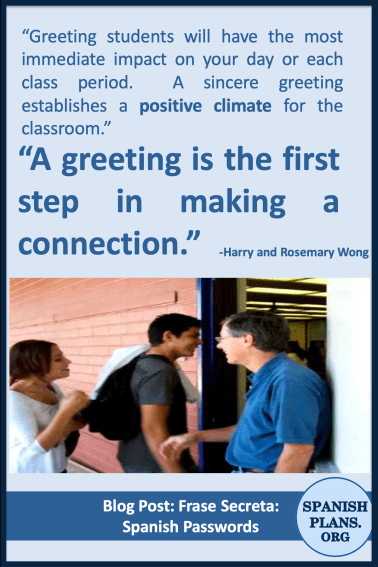
and if these reasons aren’t enough for you, let’s look at the benefits in a world language classroom who can go a step further and implement a “password” or “secret phrase” where students must respond with a special phrase of the week. The curriculum benefits are:
With the release of a new graphic novel by the Señor Wooly company, we wanted to give you some ideas on how you can teach with a graphic novel. If you are not ready or don’t have the funds to purchase a class set, don’t worry… graphic novels are a great addition to your FVR classroom library that students will be motivated to read on their own. However, if you have a class set you can also use it as a little unit. So here are some tips on teaching the graphic novel “Billy y Las Botas”:
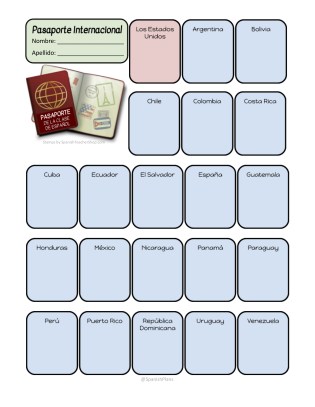
In the past, we’ve used our Passport Template to include stamp-able pages in the  passport. There are many applications for using this: marking off I-Can-Statements, marking off completion of certain tasks or units of study. Personally, in my classroom, I use them as students finish reading novels about Hispanic culture. Recently, we re-designed some of our stamps and one of our customers and fellow Spanish teacher shared with us a template she uses with her stamp set.
You can download the one page template for free here which has a space for every Spanish-Speaking countries (image on left) See how it looks filled up with our stamps (on right).
With over 400 entries, we are pleased to announce the winners of our Graphic Novel Raffle: Melanie M, Zack D, and Elizabeth D. Winners have been emailed.
Melanie was our grand prize winner and will be receiving 2 Graphic novels straight from Colombia (Toy Story 4 and Coco), 2 Senor Wooly Graphic Novels (La Casa de la Dentista and Me Llamo Victor) as well as an Avengers comic book in Spanish.
If you didn’t win, don’t worry, we have more raffles and giveaways planned for this month, so stay tuned! (INCLUDING AT THE BOTTOM OF THIS POST)
But for those who are interested in Graphic Novels, you can download a 10 page preview of the Toy Story 4 Graphic Novel (link below)
You can also check out these graphic novels of popular tales on Amazon (although the quantities are limited, so if you are interested, I’d suggest moving fast on the purchase):

On this product page, click “leer un fragmento” for a free 10 page preview.
ANOTHER CHANCE TO WIN: Continue reading
With the release of a new graphic novel and November being the month to show thanks, we wanted to host a giveaway for Spanish teachers. One of the best things about Graphic Novels or Comic books is that the illustrations are a huge aid to comprehension. Also the willingness to read typically skyrockets which means we get to provide our students with enjoyable input, a key component to any FVR time.
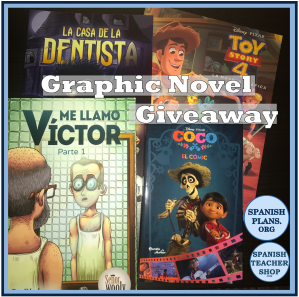
So without further ado, let’s see what you can win: Continue reading