When teaching adjectives with estar for feelings, I take advantage of an “Emociones” poster, which the students love. I give each student a post-it note and have them write their name on it. They then stick it to the picture and word of how they are feeling that day. I also like to introduce these feelings during the school unit. This way we can incorporate how students feel during specific situations. Maybe because of an upcoming test, they are feeling nervioso, or are confundido about their science lesson, or enojado with all their homework. There are so many possibilities to use these feeling words in context.
Zachary Jones @ZJonesSpanish, brought up an interesting debate on twitter, by asking if fellow Spanish teachers teach vosotros and why or why not.
Some responses given:
@hmwildy: I had a prof say “they only use vosotros in Spain, we won’t learn it”. What?? There are almost 46 MILLION people in Spain!!
@Chic_Educator86: I don’t explicitly teach it either, but bring it up and tell students when/where its used
@ceiligirl69: I do teach vosotros because my students are more likely to visit Spain or Latin America & 1 of those trips may be 1 with me
@hmwildy: Why not teach it? I wasn’t taught it and then went to Spain and felt like a total idiot! Wish it was taught more in the US!
@crepeaunutella: #vosotros I do because I use it when I give instructions to my classes
@zimmerja: #teamvosotros because even though it isn’t used primarily the students should know it just in case. I don’t use it orally
@crepeaunutella: My verb flowers would look bizarre with only 5 petals! :o) #vosotros@stephgonz: always teach vosotros! i teach it because i never learned it as a student and then was beyond confused in Madrid!
@sraoconnor: I introduce vosotros but do not assess it. I did not learn it as I grew up in Mexico so it is not natural for me to use.
Personally, I do NOT teach vosotros in my Spanish class. Let me point out that I teach in Chicagoland, which is in the middle of the United States of America. If was teaching Spanish to students in England or Germany, it would make more sense to teach it. However in the U.S. it does not seem to be relevant. According to US Census data from 2010, below are the numbers of Hispanics in the US:
Click to Enlarge
According to this information there are 50,477,594 people of Hispanic origin in the US. We can also see that 63% are Mexican, 9% Puerto Rican, 7.9% Central American, 5.5 South American, and just 1.3% Spanish.
Again, let me repeat that last number. 1.3% of Hispanics are actually Spaniards, or just 635,253 out of over 50 million. For me, the actual purpose of our programs are for our students to be able to communicate in the target language. Hopefully, they will continue to study and become fluent and maybe even use it in their job one day.
To teach our students to use vosotros is not natural. It would be extremely uncommon for them to come across its use in the United States. The 98.7% of people they encounter do not use vosotros. The rest of the world does not use vosotros and many native speakers continue to mock the Spanish for their lisp and use of vosotros.
I have traveled to Spain. Did I use vosotros? No. Did I understand when the natives used vosotros? Yes.
I have traveled to Latin America. Did I use vosotros? No. Did anyone use vosotros? No. But what they did use is “vos”, which is something many teachers who teach vosotros fail to even recognize. They have such a “Eurobession” that they ignore the majority of the Spanish speaking world. But the discussion on “vos” will be for another day…
Let me finalize this by putting it into an analogy. Teaching vosotros in the United States is like teaching our ESL/ELL students to speak the British English.
So, the question remains… Is vosotros an important item for middle and high school students to learn in their Spanish class?
Would love to hear your thoughts on the subject in the comments!
We’ve talked before about having students create their own comic strips and useful websites to make them, but today we are talking about actual comics that you can use in your classroom.
I love finding comic strips that deal with the current vocabulary theme or grammar concept we are currently working on. I’ve collected numerous comics over the years, as I receive a comic in my inbox daily from gocomics.com. Did you know they had comics in Spanish? My favorite is the authentic Condorito, but I do enjoy a good Ziggy too. Here are some examples that you can introduce to your class; it’s a good way to build a connection with your students, too.
During Health Unit
For more comics and ways to use them in your classroom… Continue reading →
We are celebrating El Día E with some free items today!! El Día E, la fiesta de todos los que hablamos español, is today, June 18. Read more about Spanish Day from the Instituto Cervantes.
To celebrate we are offering two FREE products today. To download these free items, all you need is a TpT account. If you don’t already have one, register for a TeachersPayTeachers account. Don’t worry; it’s free and they won’t sell your e-mail address. If you sign up today through the link above, and post a message on our Facebook, we will also give you a $5 product of your choice, FREE!
The following items are free today until Monday, June 20th. Don’t miss out on these great resources that will come in handy during August and September!
My students love using individual mini-whiteboards. If you don’t have a class set: get one now! There are several budget-easy options. The first one, is to go to a hardware store such as Menards, Home Depot, etc. Look for a big white shower board (perhaps 8’x10′), should be about $10. Then take it and have it cut in 12″x12″ pieces. Some people have claimed getting free cutting if they mention you are a teacher.
The next one is to take page protectors and stick a piece of paper, preferably cardstock, inside.
Of course, many teaching catalogs offer cheap alternatives nowadays. You can always buy it as a department or share a class set with other teachers. Need erasers? I have seen teachers use things such as old socks, old t-shirts, or any other used fabric.
In terms of using the boards, they are several ways that allow you to quickly assess students. Besides posing a question to the class and having students write their answers, or having them translate something, here a few unique game ideas:
Give the students a vocabulary list. Have them write a Spanish word on their board. The teacher then calls out one word in English. Whoever has that word on their board should stand up. If more than one person has it, the person who stood up first earns a point.
Put students in groups of three. Give commands, such as “Escribe una verdura verde” or “Algo que comes para El Día de Acción de Gracias” or something that has multiple answers. The three students in the group are competing against each other. You can decide to award points for having a unique answer (no one else had their answer) or for matching a answer with their group (two of the three match=5 points, all three match=10 points). You can play for a specific time (probably 10 minutes) or until a group reaches a certain point level.
Building listening: Describe a scene to your students. Or have your students describe something to each other. Have partners seated across from each other and the other person must draw what is being described. Can be used for many thematic units (House, Body, Around town, School)
Example: Spanish Body Parts Drawing for Listening
Oh, and don’t forget to have students bring in their own Expo dry-erase markers. If they borrow mine, I tell them they are not allowed to draw or write unnecessarily with my marker and waste the ink. If they do, I take the marker away and make them write on paper.
I’ll admit, I used to say I would never get a twitter account. I didn’t see the purpose and besides what did I have to say that would be important to anyone to read? I thought twitter was just for famous celebrities or businesses. In the 7 months since I’ve been a part of Twitter, I’ve have come to learn many things.
Twitter as a PLN
Granted, I first had to Google what exactly a “PLN” was that I kept seeing everyone mention. Well, this “Personal Learning Network” is composed of fellow teachers and educators who share tons of useful information, exciting web tools, and networking! You’ll be amazed at the number of teachers who are using twitter to network and learn.
Free Professional Development
With your own PLN, connected to hundreds of other educators, you will be able to get free professional development everyday you log in. No need to pay for those expensive workshops and conferences. I have been able to receive so much knowledge and ways to improve my teaching from twitter. The links and educational tools that teachers have shared have been amazing and I would not have found them without being connected on twitter.
Taking Advantage
Besides regular tweets, many educators participate in Twitter “chats”. By using a hashtag, a word follow by the number sign (#), you can follow conversations. Most take place on a weekly basis and topics are decided ahead of time. See a list of chats here.
One of my favorite Latin artists to listen to, Jesse & Joy, brother and sister duo from México City, are a hit with my Spanish students. Their music is extremely catchy and very easy to understand, especially for beginning level students. I like to play music at the beginning of class as students come into the room work on their bell work.
Check out their website jesseyjoy.com for more information.
Their first album, Esta es mi Vida, features such hits as Espacio Sideral, Esta es mi Vida, Llegaste tú, and my favorite, Volveré.
Their second album, Electricidad, features hits Si te vas, Electricidad, Chocolate, Adiós, and many more!
And good news, their first single, “Me Voy” from their new album is expected to come out late June 2011 September 5th, 2011 and their new album “¿Con quién se queda el perro?” near the end of October!
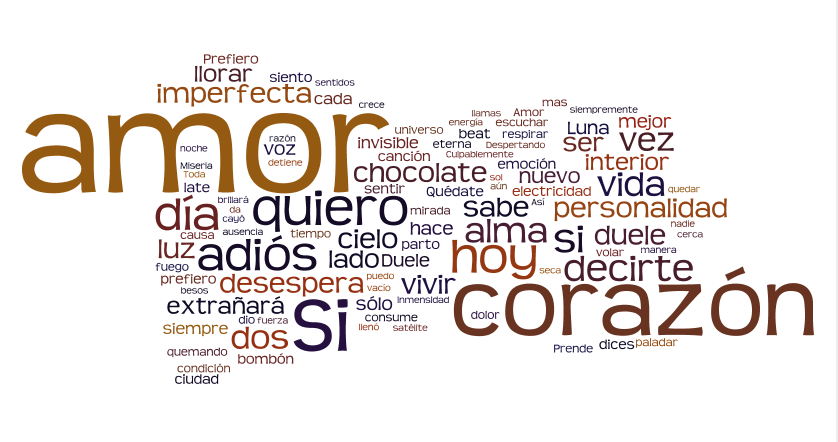
My students love the creative music video for Chocolate, and apparently almost 2 million youtube viewers agree. Using wordle, I have created a word cloud, using their lyrics from the album Electricidad. The bigger the words are, the more times they appear. Here is the result:
For another wordle and an activity involving J+J for your Spanish class: Continue reading →
I took the lyrics from Maná’s new album “Drama y Luz” and created a wordle. If you’ve never used wordle before, you can paste in text and it creates a word cloud of the most common words. You can have it ignore the most common words in the language (Hence why you don’t see subject pronouns, prepositions, articles, and other simple words that you would hear in the actual lyrics.
As you can see, the theme of the album seems to be on AMOR. Since it appears as the largest text, it is the most frequent word on the album. CORAZÓN and DOLOR are also frequent themes in the songs.
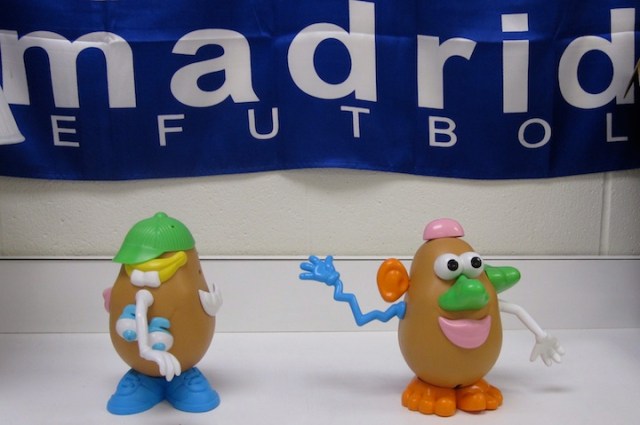
It’s getting that time of the year: Garage Sales. As a teacher, garage sales are a great opportunity to find cheap items that you can incorporate into your classroom. Today’s idea features the classic toy Mr. Potato Head. I found 2 Mr. Potato Heads in a plastic bag for 50 cents each. Go to a retail store and you’ll pay between $8 and $30. So how can we incorporate this childhood toy into our Spanish class?
A day or two after introducing body part vocabulary, as students enter the room, I hand them a Mr. Potato body piece. I then take out the “body” of the potato and place it on a desk in the front of the room. I then proceed to ask questions, such as “¿Quién tiene los ojos?” or “Quién tiene una oreja?” As students raise their hand, I direct them to put it on the potato. “Pon el brazo en la papa” or “Ponlo en la papa” using commands and direct object pronouns.
As you can see, I let the students put it wherever they want. We then vote on their favorite or “el más guapo”.
For more pictures and other Lessons for los Partes del Cuerpo…
When I studied Spanish in high school, I never quite understood the concept of reflexive verbs. Now, as a teacher, its one of my favorite topics to teach! Make teaching reflexives verbs fun, interesting, and engaging for your students.
I show my students the Solecitos video clip of “Sr. Cepillo“, a video about brushing your teeth: (Hay que cuidarse los dientes… lávate los dientes por lo menos dos veces al día)
At first the students think its a bit strange. By the fourth time, they are getting the song stuck in their head. The next day, I play the video again, but this time, I have my own “Señor Cepillo” that I use to mimick the motion of the video. The kids all want to use it!
All you need to do is take a yard stick, cover it in construction paper, and then cut another sheet of construction paper into strips for the brushes. The result: For more ideas on teaching los verbos reflexivos, keep reading… Continue reading →

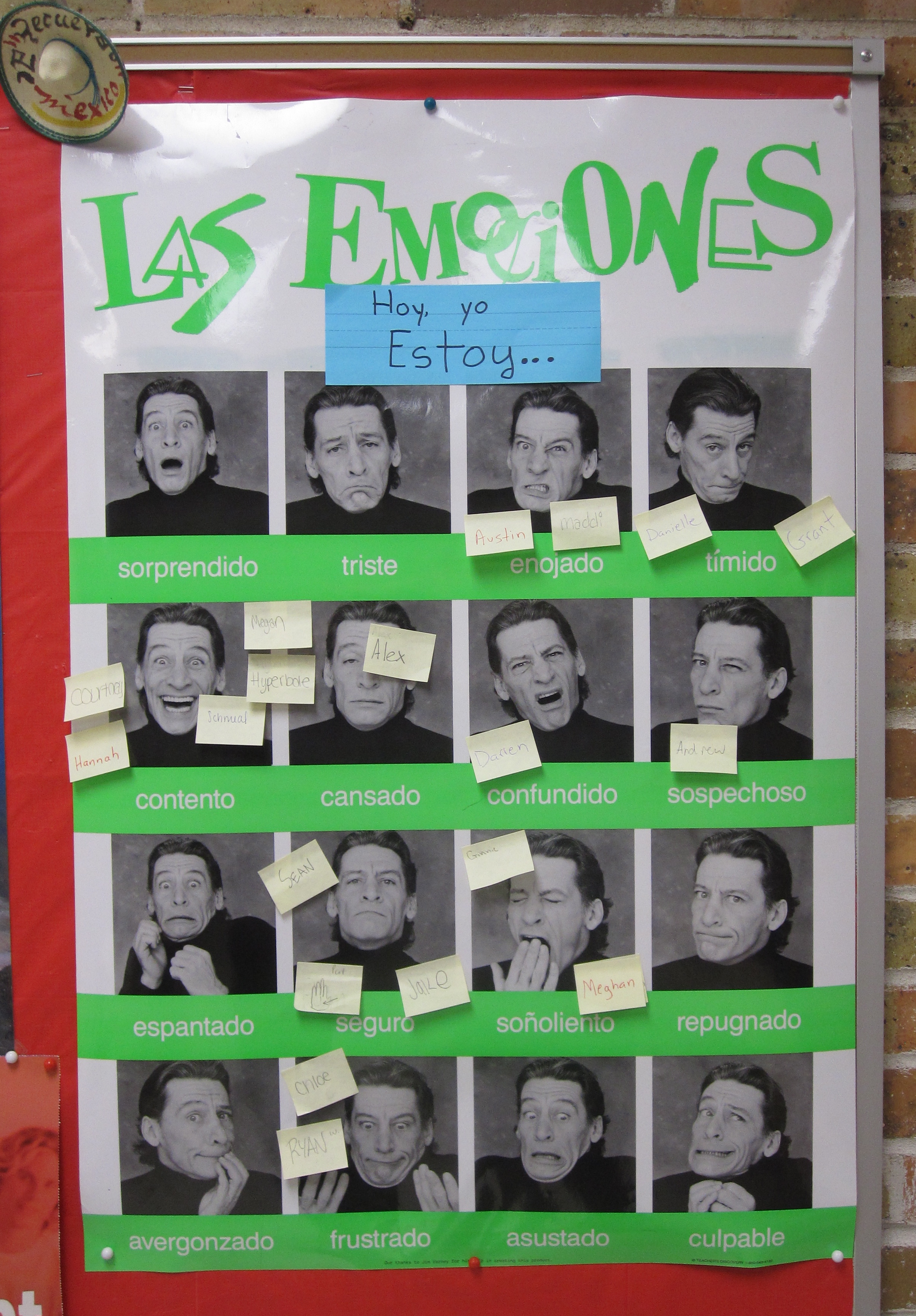 I also like to introduce these feelings during the school unit. This way we can incorporate how students feel during specific situations. Maybe because of an upcoming test, they are feeling nervioso, or are confundido about their science lesson, or enojado with all their homework. There are so many possibilities to use these feeling words in context.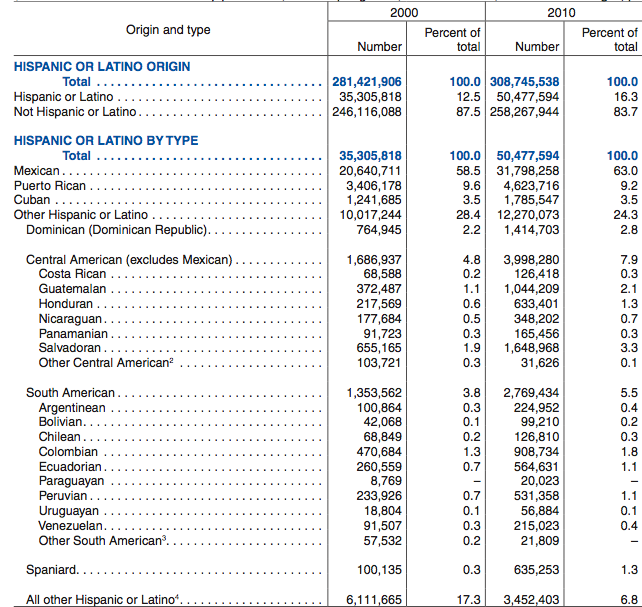






 For more ideas on teaching los verbos reflexivos, keep reading…





 SpanishPlans.org