Music Bulletin Board

In conjunction with one of my recent assignments, which students seemed to enjoy, I decided to put up a new bulletin board on the theme of music. I play música quite a bit in my classes and dedicating a tablón de anuncios was something I’ve been thinking about for some time.

Album Booklets

I used the CD album booklets as well as articles and pictures from magazines that I’ve collected over the year. If your school library has a subscription to People En Español, that’s a good place to start. I also bought some pop-culture Spanish posters drawn by MartinMRochaArt.com including this Adele poster, which students loved! Many students also enjoyed the Beatles posters.


I then made a poster asking students ¿Qué es tu canción favorita?” with a column for Spanish songs and English songs. It allows students to share their own interests and allows them to connect their world with the Spanish speaking side. I hung this poster right next to the bulletin board. Students are sure to be checking this out before class to see what type of music their peers listen to.
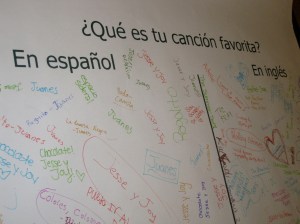
 

The end result is this bulletin board:

Edit:

We now have available for purchase this Juanes poster at SpanishTeacherShop.com: La música es el lenguaje universal.
Juanes Music Poster


Posted in Bulletin Boards, Music | Tagged , , , , , , | 4 Comments

Central States Conference 2012

Day 1 of the Central States Conference on the Teaching of Foreign Languages (CSCFL) has concluded and we are resting up in anticipation of Day 2. We’ve heard many great things coming out of the many sessions. You can track the talk with twitter hastag #CSC12 and perhaps find some other Foreign Language teachers to be part of your PLN (Personal Learning Network).

We’d like to thank everyone who stopped at our booth today in the exhibition area. Like you, we are current teachers not corporate reps. We look to bring creativity into the classroom by publishing our own materials of engaging lesson plans and classroom decoration. We will be back tomorrow with our postcards, Spanish curriculum materials, Pop Culture music/movies Posters, and more! Los Juegos del Hambre Poster seems to be popular and with posters at buy 2 get 1 free, how can you go wrong?

Spanish teacher and artist, Martin Rocha, takes time for a picture. His prints of his colored-pencil drawings feature pop culture icons of movies and music such as the Beatles, Adele, Captain America, and Thor among others. It’s a great way to connect with your students with these amazing posters for your Spanish classroom. If you were unable to attend the conference, look for these posters coming soon to his website MartinMRochaArt.com or be sure to like him on facebook as well.

For more pictures and information….. Continue reading

Posted in Resources | Tagged , , , , | Leave a comment

Exploring Spanish

We often listen to Spanish music in my classroom. As students come into class and start on their bellwork or as they are working on certain activities, I will frequently have the CD player with some Juanes or Jesse & Joy, or some other latin artists. The students have come to love the music and even request particular songs from time to time. Other times, we do listening activities where the students fill in blanks to the lyrics of a song, put cut-up strips of the lyrics back in order, or listen for particular words. Sometimes we even watch the video (love not having Youtube blocked!!)

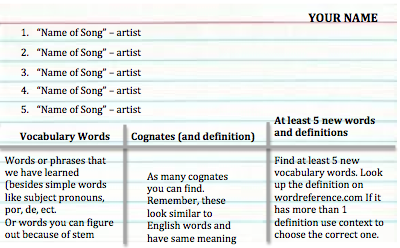
What can I say? I am a huge advocate for music in the classroom. So I came up with the the following assignment as a way to get students to explore some other songs that they might not get a chance to listen to in class. With the availability of music through the Internet and Youtube, our students have the ability to seek out and listen to many different types of music. The assignment is simple: have students look up 5 different latin artists and then choose one to look up the lyrics for. I have them look at the lyrics and fill in the assignment on a basic 3×5 notecard.

For the above image plus a list of various artists, view the PDF.

Posted in Music | Tagged , , | 2 Comments

CSCTFL

In one week, the Central States Conference for the Teaching of Foreign Languages will be underway in Milwaukee, Wisconsin. We are proud to be an exhibitor at this year’s conference. Friday and Saturday, March 9 and 10, we will be offering Spanish materials for great prices in the exhibit hall. Please come visit our booth.

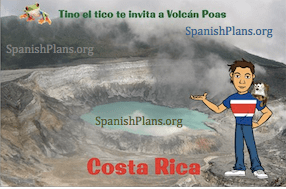
Thanks for all who voted in our previous poll on the 4 pictures of Costa Rica. Picture 4, of Volcán Poas, has been selected our winner. With this winning photo, we have designed a poster that we will be offering for sale at the conference. (In the future we may also design a poster with the catarata from picture 2)

Poster of Volcan Poas, Costa Rica

This will be available for purchase (without the site name), along with MANY other posters, postcards, mousepads, t-shirts, teacher resources and more!

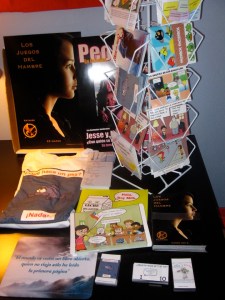
Here’s a very small preview of some of the items we will be offering for sale:

For curriculum Spanish resources, you can check out our store now or check out the covers of some of our more popular products here.

We hope to see you there. If not, be sure to follow conference tweets with hastag #CSC12 or follow their tweets @csctfl. And welcome to all our new Twitter followers of @spanishplans and participants of #langchat. If you are new, you can read past summaries of weekly professional development chats at the #langchat summary archives brought to you by Calico Spanish.

Posted in Resources | Tagged , , | Leave a comment

Ser and Estar

One of my favorite grammar points to teach is the difference between the verbs SER y ESTAR. While both verbs mean “to be” in English, in Spanish they couldn’t be more different. I know many teachers use an acronym to teach this sometimes difficult topic.

Ser:
DOCTOR (Description, Origin, Characteristic, Time/date, Occupation, Relationship)
DON’T (Description, Origin, Nationality, Time)
JETCO (Jobs, Events, Time, Characteristics, Origin)

Estar:
CLIFT (Condition, Location, -Ing verb, Feeling, Taste)
PLACE (Position, Location, Action, Condition, Emotion)
ELF (Emotion, Location, Feeling)
HELP (Health, Emotion, Location, Present Progressive)

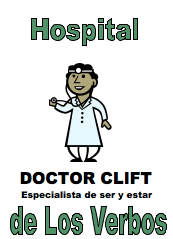
My favorite is DOCTOR and CLIFT because I use the idea to create a character of someone who is an “especialista de ser y estar”. I totally play this up, telling my students that they will have a guest speaker as a substitute and that I will not be in class because I have “meetings”. On that day when they see that the “guest” looks a lot like their regular Spanish teacher wearing a lab coat and wearing a guest ID badge, they start to think I’m a bit crazy. But I’m ok with that.
They soon realize that the “Doctor” doesn’t speak any English at all and responds best when spoken to in Spanish. Although, he does rely on the students to help translate certain things to clarify for struggling students.

For a copy of this particular lesson, a 19 page document, including an ID badge, guided notes packet, over four pages of worksheets, and a quiz, click here.
For more Ser and Estar resources, including Ziggy Comics…. Continue reading

Posted in Lesson Plans, Resources, Ser Estar | Tagged , , , | 2 Comments

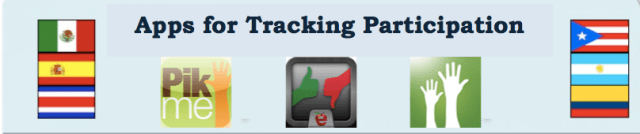
Participation Apps

1. Pikme (Free) by Smitesh Bakrania

Can randomly select students with a shake. Or can scroll to a particular student. Upon answering a question, you can rank the student’s response one, two, or three stars. Good application if you want to rank the quality of student responses. The downfall is that there is no way to view all scores on a single page. You have to go to each student and you can see their question average, and you have to click on another button to see total questions answered.

2. MyClassTalk ($0.99) by Langology


Adds a point every time you tap on students’ name or picture. You can also see a rank page of the whole class and see who has participated the most; you can also add or subtract points here in case you made a mistake. The only con is that there is no randomizer to randomly call on a student.

3. Pick Me! ($1.99) by ClassEapps


Easy to sort students by name. Can “spin” to select a random student or scroll to a specific student. You can keep track of if the answer was correct or incorrect by pressing thumbs up or thumbs down. Shows you the students’ score on the same screen, you don’t have to go to an extra page to see how many questions they have answered. You can also have it set to remove students from the list if you don’t want to call on repeat students, although it is real easy to add them back into the pool.

Conclusion: Out of the three, “Pick Me!” by ClassEapps, seems to be the best. The features I liked are that you can keep track of the number of correct and incorrect answers while also being able to see the numbers of all students on the same screen. The easiest to use is probably “MyClassTalk” because you simply just tap the student’s name/picture every time they participate and a majority of students are visible without scrolling. Ultimately it depends on what you are using the application for. If you are just looking to see how many times a student participates then “MyClassTalk” seems to be best. If you are looking for the quality of responses, then the free “Pikme” would suffice. If you are looking to track the number of correct and incorrect responses, your best option is probably “Pick Me”

We’d love to hear your feedback. Have you used any of these 3 applications or other Apps in your classroom? What suggestions would you make to the creators? Post your comments below.

To have some fun, if you want to “subtract” points, issue students a “red card” every time they speak in English.

Posted in iPads, Speaking, Web2.0 Technology | Tagged , , , , | 3 Comments

Adding some culture to info-gaps

We all use info-gap activities with our Spanish students to engage them in the foreign language. These are the activities where they must ask their partner for missing information and likewise, respond to their partner’s questions. Some texts books have some very good ones. At the top of the page, it designates one person as “Persona A” and the other as “Persona B”. Well, why not get the white out out and make each a bit more interesting than A and B. Try incorporating culture by writing the names of famous latinos on each page.

Try these famous duos or pairs of Hispanics:

  • Jesse Huerta y Joy Huerta (hermanos de Jesse & Joy)
  • Rodrigo y Gabriela (guitaristas mexicanos)
  • Frida Kahlo y Diego Rivera (artistas mexicanos y maridos)
  • Juanes y Shakira (cantantes colombianos)

    "Persona A y Persona B" o "Pique y Shakira"

  • Shakira y Pique (novios: cantante colombiana y fútbolista español)
  • Che Guevera y Fidel Castro (revolucionarios)
  • Gabriel García Marquéz y Octavio Paz (escritor colombiano y escrito mexicano)
  • Pablo Picasso y Salvador Dalí (artistas españoles)
  • César Chávez y Dolores Huerta (fundadores de United Farm Workers)
  • Diego Maradona y Leo Messi (dios argentino/fútbolista y su sucesor)
  • Presidente actual de México y President actual de otro país latino
  • Pancho Villa y Emiliano Zapata (revolucionarios mexicanos)
  • Salma Hayek y Penelope Cruz (amigas: actriz mexicana y actriz española)

Any other famous pairs? Feel free to add to this by leaving a comment below. Gracias.

For an info-gap activity… Continue reading

Posted in Culture, Speaking | Tagged , , , , , | Leave a comment

Sticking to Spanish

One of the biggest struggles when you have a class of 20-30 students is to engage them in speaking the language. While obviously it would be nice to converse with them one-on-one or pair them up with a native speaker, our best bet is to pair them up with another classmate for partner work. Unfortunately, students sometimes do not remember the point of the exercises: to communicate meaning in the target language.

I often will remind students of the purpose of the activity and remind me that the objective is to not get ALL of the answers as quickly as you can or to just fill in the worksheet. The objective is to practice speaking Spanish. A reminder of this fact every so often seems to be helpful.

One way to try to keep students in the target language is to provide them with possible questions they may need to ask their partner. A lot of students do not know how to verify their answer or their partner’s response. Especially in gap-fill activities, students frequently want to verify what their partner has said. By putting these questions up on the board, it allows students to stay in the target language while being able to complete the activity.

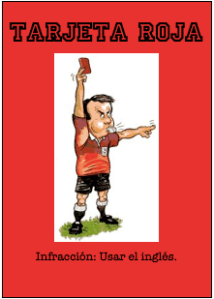
A fun way to get students to stay in the target language is to have students police themselves. Using the concept of the culturally-supported sport of fútbol, students act as the “referee” to their classmates. They can issue a “tarjeta roja” to offending students. You can use this as a gentle reminder, or you can even use it to downgrade student participation grades much like some teachers use a Págame system in their classroom.

 Download a FREE printable tarjeta roja
For communicative activities…. Continue reading

Posted in Discussion/Methodology, Resources, Speaking | Tagged , , , | Leave a comment

Lenguaje de text

Se llama “SMS” y son mensajes cortos. Se usan especialmente en los mensajes de text o email. Aquí una lista de las más usadas y comunes “Text Speak” en Español:

x = por
k = que
xq= porque / Por qué
nls = no lo sé
vdd? = verdad?
a2 = adíos
bs, bss = besos
b7 = besitos
bb= bebé
tq = te quiero
tkm = te quiero mucho
ntp = no te preocupes
nkv= nada que ver
s-lente= excelente

texting in spanish

To see more and see a video of a vlog in Spanish discussing this very topic….. Continue reading

Posted in Vocabulary, Web2.0 Technology | Tagged , , , , | 1 Comment

10 Freebies and win $10

We are please to announce the following contest which will award 2 $10.00 gift certificates to TeachersPayTeachers.com. Participation is free. All you have to do is like our page on facebook or refer a friend to “like” our page. To enter the contest and be eligible for win $10.00 click this link.

If you aren’t yet on TeachersPayTeachers, what are you waiting for? There are over 450 FREE Spanish lessons. Billed as the e-bay for teachers, you can find thousands of classroom tested lessons ready to print and use in your classroom. It’s free to join and you only pay if you purchase a product. Not sure? Just one of our following free products (You will need to register/login to download free items. You may also need to be logged in to be taken directly to the page linked in the pictures):

10 Free Spanish Resources:
1. Preterito AR 4 page packet describing the difference between presente tense and past tense (preterite/preterito) for -AR verbs including the irregular -Car, -Gar, -Zar verbs.

2. Poder de Saber This 12 slide powerpoint features 10 statements which ask students to decide if they are true or false. Click ahead, and it will tell you the answer and also give an explanation.  These are 10 things that a lot of students don’t know, but they definitely should. Features common misconceptions about the Spanish language worldwide and in the US as well as about the people who speak Spanish.

3. FREEoralactivity 20 questions for students to ask each other regarding chores and what they have to do around the house. Students ask the question orally and write down the names of their classmates according to their responses. Great way to get the students speaking Spanish!

4. Free Download A zipped file containing a PDF file and an editable Word file of 4 pages: 1) Blank Verb chart 2) Blank Verb chart with selected infinitives 3) Filled-in Verb chart for selected infinitives 4) How to make Subject Pronoun graphic organizer and link to 3 other conjugation / subject pronoun organizers. This product helps beginning students learn how to conjugate verbs based on the subject. Can also help advanced students keep track of forms in the different tenses.

5. How to record Audio on GarageBand
6. Homework Not Done Note to Parents
7. Free Magic Squares Template
8. Family Tree Vocabulary FLIPCHART
9. Cognates Spanish Cognados List
10. Affirmative Informal Commands Powerpoint Notes

Posted in Free | Tagged , , | Leave a comment