Hispanic Heritage Post 1

During Hispanic Heritage Month (September 15 – October 15) we will be posting articles and information relating to the impact of Latinos in the United as well as looking at their culture from their home countries. Our goal is for Americans to realize that Mexico and other Hispanic countries are more than just stereotypes.

Our first article comes from NBC Latino and is titled “Poll: 1 out of 3 Americans inaccurately think most Hispanics are undocumented” According to the article:

.

“A new poll released by by the National Hispanic Media Coalition and Latino Decisions finds over 30 percent of non-Hispanics believe a majority (over half) of Hispanics are undocumented.  However, the actual figure of undocumented Hispanics in the U.S. is around 18 percent, and only 37 percent of U.S. Hispanics are actually immigrants, according to the Pew Hispanic Center.”

However, if you read the comments section of this article (something I don’t recommend) you will still see the negative, racist, and ignorant views of some posters. (Although, sadly, this occurs on almost every online news story.)

So the question is: how do we educate our students about the reality of Latinos in the US?

During the end of the year, I show a ’30 Days’ documentary showcasing the different perspectives on illegal immigration in the United States. I ask my students to pre-journal and post-journal with their thoughts on the topic. Some students change their opinions, some have their opinions confirmed, but they all can view the topic from a different perspective.

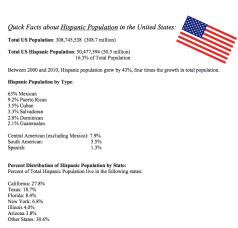
One thing that is very eye-opening is actual facts and numbers in regards to latinos and the rest of the US population. You can download our FREE Hispanics in the USA lesson that includes information about the Hispanic Population from the 2010 U.S. Census and also information about the Foreign-Born population living in the United States. According to the census, 16.3% of the total population is Hispanic, yet 63% of those are born in the United States. Or using data from the foreign-born population from the 2000 US Census that refute such beliefs that Hispanics ‘don’t learn English’; they do; Of the 43% of foreign-born that speak Spanish, 70% Speak English ‘very well’ or better.
(edit: Updated data from 2014 available here)
What about you? What sort of lessons do you use in your classroom to promote the Hispanic culture and its people?

Have an article you would like us to highlight this month? Contact us.
Posted in Culture | Tagged , , , | Leave a comment

September 16th

¡Viva México!

Feliz día de Independencia, México, querido y lindo.
Read our previous Independence Day post or download láminas sobre México.
Continue reading

Posted in Culture | Leave a comment

Bulletin Board 2012

In conjunction with my switch to a more proficiency based classroom, I decided to dedicate one of my bulletin boards this year to proficiency levels and the four modes of communication.

The main bulletin board I used for the Listening and Speaking sections, Escuchar y Hablar. For each section, I copied the ACTFL descriptors of a novice learner and a intermediate learning, since these are the ranges my students will be in. I also included the capabilities at Novice-Low, Novice-Mid, and Novice-High for each. In the middle are 3 motivational posters. Continue reading

Posted in Bulletin Boards | Tagged , , | 2 Comments

Animales

I start my 8th grade class off with a lesson about Animals in Spanish. Animals is one of the topics that students really enjoy but you don’t see it included in many textbooks or early levels, so it is something that I definitely make sure to include in my curriculum. It is a fun topic where students can learn new vocabulary words and apply past learning for review in talking about animals.

I include about 20 animals for vocabulario. I have these words loaded up as flashcards on wordchamp.com so after the introduction of the words, I display a picture of an animal on the board and ask students “¿Qué animal es?” as they look through their notes to tell me the word. When I hit the ok button, the computer pronounces the word so they get to hear the correct pronunciation. Animals is such an easy unit since many of them are cognates.

One activity that I do is have the students watch the video for “Chocolate” by Jesse y Joy. As they watch the video, when they see an animal in the video, they put a check mark next to the word in their notes. (Objetivo: Identificar los animales en el video)

It’s a fun video and I’ve also used it during the food unit as it talks about many food-related vocabulary words.

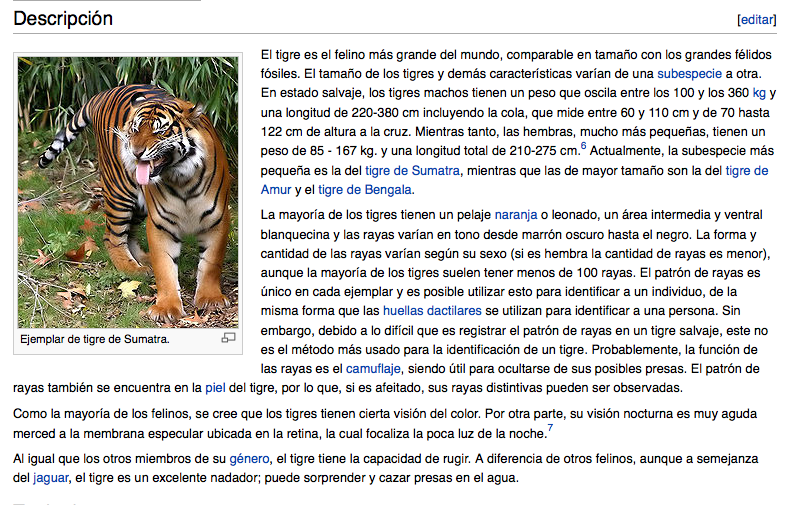
The next day, I hand out flashcards in Spanish I’ve accumulated through my travels (1-2 per student). They read the description of the animal and write down any cognates they find. If you don’t have cognates, you can look up animal descriptions on Wikipedia Español:
I then have them do a small project where they have to describe an animal. I allow them to pick one of the animals they have or they can create a new animal by combing the two. (For example: vaca + tortuga = tortaca”) Or you can have them create their own superhero using the animal, since many are already based on animals:  Spiderman= Hombre de Araña. Batman= Homre Muerciélago. I give them some vocabulario adicional to use in their project such as patas, volar, poderes, cola, etc.

Lastly, I also have a variety of libros en español that I lay out on the counter for students to read through. But my favorite is called “La vaca que decía OINK” por Bernard Most.  I have the students sit on the floor and read them the story, hamming it up. The students enjoy the feel of sitting in a reading circle much like they would do in the primary grades.

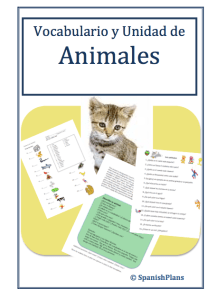
This is a pretty easy lesson to put together. But if you are in a hurry and want to implement the lesson now, we’ve done all the work for you. You can get the whole unit which includes: Spanish Animals Unit
-26 Vocabulary Words Listed
-1 page Animal Project
-3 pages of pictures/clipart
-1 Page of 17 Questions
-1 Multiple Choice Quiz

all for less than $2. Quite a bargain, if you ask me.

Recursos Adicionales:
-Esta actividad de “mascotas” de Zachary Jones, Twiccionario de mascotas.
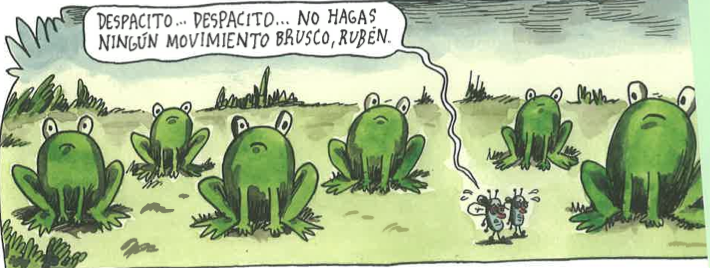
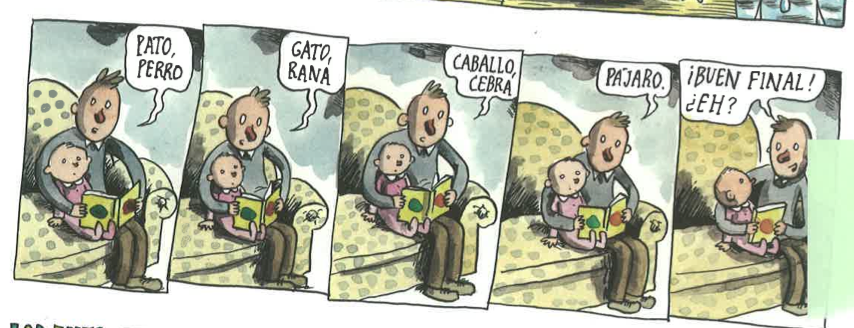
-Estas tira cómicas de Macanudo por Liniers:
I used this comic as a bell ringer. Asking: Using the cognate in the text and using the context of this picture, what do you think la mosca is saying? You can follow up with questions such as: ¿Qué es el cognado? ¿Cuántas rana hay? ¿Cuántas moscas hay? ¿Cómo se llama la mosca?

And this is another fun one:


Check out all our resources for an Animal Unit in Spanish Class.

Posted in Lesson Plans, Resources, Vocabulary | Tagged , , | Leave a comment

Macanudo

Mafalda y Condorito

In addition to being funny, the comics Condorito, Mafalda, and Macanudo can offer a great insight into the Hispanic culture and language. Mafalda, drawn by Quino (Jauquín Salvador Lavado) is a national symbol in Argentina. Condorito, the pride of Chilean comics, is brought to us by the mind of Pepo (René Ríos).

But today, we’d like to take a look at another Argentine comic. On a recent trip to South America we happened to pick up a collection of Macanudo comics at a local bookstore and not long after reading, we were already craving more and purchased several books online.

Pin this post

Macanudo is one of the more creative and original series we have seen in a long time. It combines ingenious wit and thoughtful insight to come up with delightful and hilarious strips. Macanudo is a creation of Liniers (Ricardo Siri).

Liniers, who draws himself as a rabbit (see picture, right), has created characters such as los Pengüinos, El misterioso hombre de negro, Enriqueta y su gato Fellini y su oso de peluche Madariaga, y el chico Martín y su imaginación Olga, and Z-25 el robot sensible, among many others.

For how to use these in your Spanish class and some sample strips…
Continue reading

Posted in Chistes, Culture | Tagged , , , , | Leave a comment

Spanish Notebook

It’s the second day of Spanish class and students are freaking out about their Spanish teacher speaking only Spanish in class. It’s a change for them, as they are not accustomed to being immersed in the language for nearly all of class. But at the end of this lesson, students will understand that despite the teacher speaking only in Spanish, they are doing exactly what they need to. Here’s how I implemented my plan to stay in the target language for, the ACTFL recommended, 90% of class:Setting up notebook for Spanish class on first day using only target languge

The lesson today was to organize students’ notebooks. I had bought Post-it TABS from Target. They were a bit expensive, but I used money from our parent organization. For cheaper, you can also buy Page Markers. The entire lesson was conducted entirely in the target language. I told the students we were going to organize our notebooks in five sections. I first made sure they all put their names on the front of the notebook. Then on the first page, we wrote at the top of the page and on the tab, the word “ENTRADAS“. I explained to them what an entrada was; essentially it is my term for bell work. While talking, I also took a notebook and labeled it myself, showing the class exactly what I was doing, so that they had visual reassurance. Even though some kids may understand exactly what you are saying, some need that visual assurance that they are doing it correctly.

I then told them to count ahead 20 pages for the second section and handed out another set of tabs. We marked this section as “APUNTES” and I explained that this would be the section for grammar or cultural information.

Jumping ahead another 20 pages or so, we labeled the section for “VOCABULARIO“, 20 more pages for “ACTIVIDADES” and then I told them to close their notebooks. We then started at the back of the notebook and counted 5 pages back. For the fifth section, we labeled it “VOCABULARIO ADICIONAL” on the top of the page and wrote “adicional” on the tab. I then instructed them to draw a line in the middle of the page to create 2 columns. The first column we labeled “Palabras Nuevas” and I told them that this is where we put vocabulary that isn’t from the textbook but important words we come across in class activities, from reading or listening. The second column we labeled “Cognados” and using a brief listen of a song and a quick reference to a book, we wrote an example for each.

I then told them to close their notebooks. In English, I told them I had 2 questions for them. The first:

  1. Did you understand everything I said today?
    They, of course, responded with “no”. And I told them that I did not think that they would.
  2. Did you all organize and label your notebook into 5 sections?
    They, of course, responded with “yes”, to which I responded that they had accomplished exactly what I had intended them to do.

My next discussion was to tell them that they did not need me to speak in English for them to be able to accomplish the task. That even though I spoke Spanish the entire time, they were able to get done exactly what I had intended. Some may have understood more or less than the person sitting next to them, but it did not matter; they ALL met the goal of the lesson. I told them that with the help of previous vocabulary they have studied, with cognates, and with visuals, they can get out a lot more than they think, so that when they hear all Spanish, they should not immediately shut down and not try, but to use those methods to get the main idea.

I think this explanation opened up their eyes and will hopefully alleviate their anxiety (and lessen the number of parent e-mails complaining of me speaking only Spanish). I told them that this year we will be working towards a goal; and be completing tasks. That we would not just be studying lists of vocabulary words, but working towards an objective to apply those words.

If a student studies a list of 30 vocabulary words and knows all 30 words, that is fine. But if they can not actually use those 30 words to communicate, it is not worthwhile. But if a student only learns 5 vocabulary words, but can apply them and use them to communicate, that is much better. It is not about quantity of words, but quality of conversation.

I’m really looking forward to this school year and reaching my own goal of speaking a majority in the target language.

Posted in Discussion/Methodology, Lesson Plans | Tagged , | 10 Comments

Speaking and Writing Rubrics

In our last post, we offered a short communication rubric to give to students or hang up in your classroom to motivate students to work at a higher proficiency level. Today, we are posting our Writing and Speaking rubric that we adapted from the Jefferson Public County Schools’ rubrics that are connected with the ACTFL proficiency levels.

Our goal this year is to have a communicative classroom and assess our students in an appropriate measure of what they can actually do.

Spanish Writing Rubric
Interpersonal Writing Rubric

Spanish Conversation Rubric
Interpersonal Speaking Rubric

Also, before each unit/chapter we will be handed out a list of objectives for the students. This will be divided into two sections: lenguaje and cultura and will be written as ‘I can statements’. We intend to have students self-assess themselves on this sheet at a level of high, mid, or low and use these same objectives for their formal assessments, which will be graded using the rubrics from above.

Posted in Discussion/Methodology | Tagged , , , | 9 Comments

Communication Rubric

This year we are adopting a proficiency-based classroom based on the goal of communication. All of our formal assessments will be done using proficiency-based rubrics and standards. This change in format would not have been possible without my colleagues from #langchat, who have given me many ideas and shared resources. I would specifically like to thank Amy Lenord(@alenord), Thomas Sauer, (@tmsaue1), Kara Parker from The Creative Language Class blog and the Jefferson County Public School’s foreign language department.

To start with, we adapted the following rubric from Amy Lenord to make a simple grading scale of out 5 points. Students can earn a 5, 4.5, 4, 3.5,3, or 2.5 out of 5 points to cover A+, A-, B-, C-, D-, and F, essentially what you would have as a GPA. This rubric is not intended for formal assessments, but rather to have posted to encourage the students to work towards speaking at a more proficient level.

Communication Rubric

We hope this encourages students to expand their answer and be cognoscente of how they are responding to questions and to try to work to at least a 4. To make it easy for students to understand, we have enlarged this rubric and used sentence strips to give an examples, and posted it above our whiteboard: Continue reading

Posted in Discussion/Methodology, Speaking | Tagged , , | 11 Comments

Palabras de tecnologia para usar en clase

Since I will be utilizing iPads in the classroom this year and engaging the students on the educational social media tool edmodo, among other web tools, I thought I better brush up on some technology vocabulary. I plan to do the instruction of using these tools in the target language, but I realized that  there are some words that even I didn’t know in Spanish, so I compiled a list of what my students will need to know. I thought you’d all enjoy if I shared this list as well: Continue reading

Posted in Vocabulary, Web2.0 Technology | Tagged , | 11 Comments

Taco Bell in Mexico

A lot of Americans assume that Taco Bell is Mexican food simply because it sells things such as “tacos”. But claiming that Taco Bell sells Mexican food couldn’t be further from the truth. To claim such is a great insult to actual Mexican food. Nevertheless, I have to really convince my students that this is the case. Many do not believe me when I tell them that Taco Bell is not Mexican food.

Taco Bell is an American restaurant that sells American-style Mexican food. At best it could be called Tex-Mex food. Let’s start with the taco. Taco Bell sells a hard corn shell filled with “ground beef”, lettuce, tomato, and cheese. An truly authentic Mexican taco is served on 2 small corn tortillas, topped with meat, cilantro, and onion.

Chalupas? Try asking a Mexican what a chalupa is. Most have no idea. Taco Bell’s burritos and gorditas don’t even come close to the real thing. And nachos? Again, more of a Tex-Mex thing than anything else.

Taco Bell is Not Mexican Food

Also in Spanish

But here comes the stunning news: Taco Bell has opened up locations in Continue reading

Posted in Culture | Tagged , | 9 Comments