In addition to the TeachersPayTeachers Cyber Monday Sale, we have some other special announcements: Continue reading
-
Search our site:
-
Join 1,151 other subscribers


Top Posts
World Language SLO
SpanishPlans on Facebook
Spanish Lessons
In addition to the TeachersPayTeachers Cyber Monday Sale, we have some other special announcements: Continue reading
Oh my god, you guys!! Look who visited my class today! 
I had my fan girl moment as Juanes was part of our class story. We’ve also had visits previously from Beyonce (not Bey-doce or Bey-trece), John Cena, Cristiano Ronaldo, and Kanye West. But you are in luck. You can have them visit your classroom too…. Continue reading
We just finished up our La Llorona Unit, which was our first story in  Spanish 1 that we introduced in the past tense. Our prior stories this year were all present tense. Our Llorona story featured the background of the legend itself and then included a brief movietalk.
We had the following targeted structures written on the board throughout the story. We used the 3rd person past tense to narrate the story and by incorporating student actors, we could ask the actor  a question in the tú form and have them respond in the yo form to get reps of the 1st and 2nd person in present tense.
Students were already familiar with the structures of tiene and busca as well as the present tense of hay, está, and es. Through the background story of Continue reading
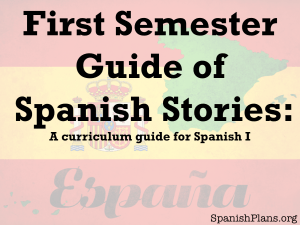
These are the stories that I’ve used in my first semester 8th grade Spanish class (Level 1).
Wildebeest Movietalk: Hay, Dice, Ve. Martina Bex has this great Embedded Reading/Movietalk which is a perfect thing to start the year. This lesson you can download for free.
To go along with the video, I teach other common animals and we watch the video el  Pollito Pio.
I then read them the book La vaca que dice Oink, (preview here) which we use to talk about the benefits of being bilingual. Through the story, it is totally comprehensible and gets in the rep of dice. You can also use this video as MovieTalk about a pez that says Gua Gua.
I also used the book “Oso pardo, oso pardo, que ves ahi”.
 The next story was Va a Mexico that focuses on the strucures Va a, Tiene, y Está en. I use this story after students put together their class passport.
To go along with the structures of “va a” we listened to the video Continue reading
 I’m sure by now you’ve heard about this song and video. If not, you’re gonna love it. Here’s how I recently used it in my class:
1. Students work on “Soy Yo” packet by Kara Jacobs. I used 5 pages: the vocab page, the paragraphs where students write out the Spanish word by pulling the vocabulary from the paragraph, the full story (circle the answer), and the Imaginemos page.
I actually used this as a sub plan and it took a majority of my students almost the entire 40 minute class period.
2. Students watch the video. Hopefully you have youtube unblocked at your school and have access to technology so students can do this at their own time. Otherwise, you will have to show them the video to the whole class.
3. For students who finish early, you can have them practice the vocabulary on Quizlet.
4. The next day, I have students complete an Edpuzzle activity. If you have never used edpuzzle, you will Continue reading
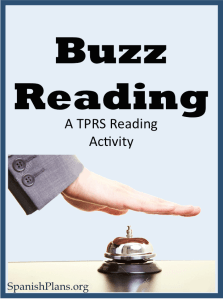 I use this technique to practice reading. It may involve a lot of re-reading, great for extra repetitions, but the students enjoy its game aspect. I call it Buzz Reading, but other names include Bell Reading. All you need is a traditional classroom bell or find a buzz maker sound on youtube.
Here’s what you need:
Thanks to everyone who stopped and visited our booth at the Illinois Conference of  Teaching of Foreign Languages 2016 Fall Conference.
We’d like to remind everyone that all our materials can be found on our website SpanishTeacherShop.com and FrenchTeacherShop.com
One of the most talked about parts of our exhibitor’s table was our Passport and our Stamps.
 Giving each student their own passport has a variety of functions. It gives them ownership of their learning; it introduces them to the concept of traveling abroad and learning about cultures; and it can be used to track their progress in class.
Over the last several weeks we’ve been working to expand our stamp collection. We now offer all 21 Spanish Speaking Countries (plus the US).
See below for more information: Continue reading
It’s been awhile since a blog post, and I’ve been keeping busy by attending various conferences and writing new stories for class as well as finally finishing stamp designs for all 21 Spanish Speaking Countries.
I wanted to share a really quick activity that I learned from a session by Carol Caab (of TRPS Publishing) at the first ever Comprehensible Midwest Conference in Milwaukee, WI in late September.
In this activity, the teacher provides 5 phrases in the target language. The key is to make sure that the phrases are vague enough that they leave open some sort of interpretation. Write them up on the board as A, B, C, D, E.
For example, I started with these 5 phrases:
A) Busca
B) Tiene un perro
C) Va al Pet Shelter
D) Ve un gato
E) Quiere
Granted 2 of mine are just verbs and not a complete phrase, (but this was my first time doing this type of activity, on the Monday after the conference). Ideally, they would be a bit more phrasal.
Hand out 5 cards to students with one of these letters written on them and have those 5 students come up to the class and act out whatever that phrase is. As they students are acting out the phrases, you want to try to get as many reps of the phrases as you can. So you can ask questions to the actor and the class. The trick is to try to critique the student in a playful way that allows you to get them to do the action again and again.
Have the class try to guess what letter the student is acting out.
Then have the class pair up and try to put the sentences in a logical order. The idea is that the sentences are so vague that there really isn’t an exact answer; they could be multiple ways to order them. It is up to the students to make sure it is logical. Then ask the class for which order to put them in. As you are asking groups what is first and which is second, you are getting in additional reps of the structures. Once it is established that the class is not at a consensus for which is 1st,2nd,3rd, have the students go back to their partners and try again so that the class can come to a consensus.
I put each phrase in a text box on a powerpoint so I can move the phrases around on the screen as the class tells me which one is first, second, third.

I then had students write a brief story using these 5 phrases to show us what they think happens in the story (and thus which order they are in). For example, Using the 5 phrases from above a student might say that they story is as follows:

This is a fun activity that allows for discussion and sneaks in a bunch of reps of the targeted structures. It’s one that I am keeping in the teacher toolbox and hope to get better at as I use it more and more.
We’ve all heard of “boot verbs” to teach the conjugations forms of stem-changing verbs.
Take the i–>ie stem changing verb querer:
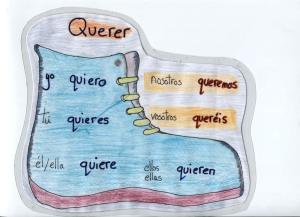
Cute, right? Well, sure….If you want your students to only be able to memorize verb forms without actually acquiring them or being able to use them in context.
At the Comprehensible Midwest Conference, Dr. Krashen delivered the keynote. As CI teacher knows, teaching verb conjugations as a way to acquire the language would not fall under the umbrella of teaching with CI. If we are using grammar concepts to teach the language, our students are probably not acquiring the language. “When your hidden agenda is the future tense it’s hard to make class interesting” – Steven Krashen.
The key is to make language compelling and personalized (and comprehensible obviously). He used the analogy of eating a well-balanced diet. In your diet, you don’t think to yourself, “well, I need to take some vitamin A now, and then later I better take a dose of protein.” If you have a well balanced diet, your vitamins and nutrients will be present in your food. Your nutrition is not sheltered. Well, grammar is the same. We do not need to have a lesson on boot verbs. Stem changing verbs by themselves should not be the focus of a lesson. Boot verbs should be part of the input we give to our students. Over time, they will acquire all the necessary structures they need to be able to use them in their communication.
With that being said, I’d like to redefine what a boot verb is. A boot verb should be a verb that you can use when talking about boots. What type of structures are compelling to students to talk about boots?
These are MY boot verbs:
 My boot verbs include Se pone, tiene, quiere, va, and necesita. I can use these verbs to talk about boots. What are your boot verbs. Share them on twitter with #MyBootVerbs or leave them in the comments. Give us a sentence talking about boots.
 What about Flip Flop verbs? Continue reading
Since adopting an ice cream metaphor to talk about performance and 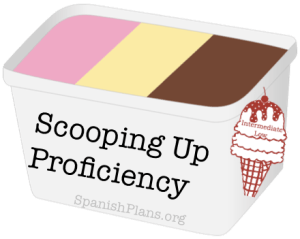 proficiency with my students, my favorite phrase to encourage students on assessments or when they are writing is: “SCOOP IT UP!”
To go along with this theme, we have created these proficiency level posters that teachers can’t stop raving about. It’s an easy way for students to see the difference between novice levels and intermediate level-type performance. Teachers have been making bulletin boards and are loving the visual that makes ACTFL’s proficiency levels kid friendly.