September 11th Segovia Colombia

While this year the talk of the date is the once in a lifetime date of 11-11-11, November 11th holds a “Never Forget” attitude for the people of Colombia.

“La Masacre de Segovia fue una masacre ocurrida el 11 de noviembre de 1988 en el municipio de Segovia (Antioquia) donde fueron asesinadas 43 personas y heridas 45, durante un ataque por parte del grupo Muerte a Revolucionarios del Nordeste, un grupo paramilitar liderado por Fidel Castaño. La masacre se realizó con el motivo de eliminar a los militantes de la Unión Patriótica que habían ganado las elecciones de marzo de 1988.” – Source.

Más Información sobre la Masacre de Segovia:
Masacre de Segovia, Antioquia (Noviembre de 1988)
Wikipedia Español: Masacre de Segovia

Be sure to check the Trending Topics of Colombia tomorrow to see what people are saying. Listen to Juanes’s tribute to these people on his song “Segovia” from his P.A.R.C.E. album
Youtube video of Segovia (with lyrics)

Full lyrics after the jump Continue reading

Posted in Culture | Tagged , , , | Leave a comment

Song for La Casa Vocabulary

As I was sitting thinking about different activities to use for the unit on La Casa in my Spanish 1 class, the song “El Edificio” by Bacilos came up on my music player. What a perfect song! This song has so much vocabulary related to the house unit, along with many cognates, that it is a perfect fit for any unit about La Casa, whether it be in Spanish I, II, or III.

For the full lyrics, see below… Continue reading

Posted in Music, Vocabulary | Tagged , , , , , | Leave a comment

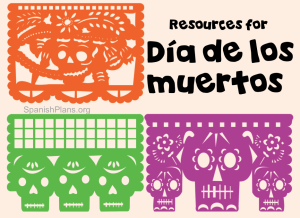
Día de los Muertos

dia-de-los-muertos-lessonsIt’s October, and if you’re a Spanish teacher that means getting ready for Halloween and the Day of the Dead. We’ve compiled some of the best resources around to give you a one stop shop for great teaching materials.

Readings

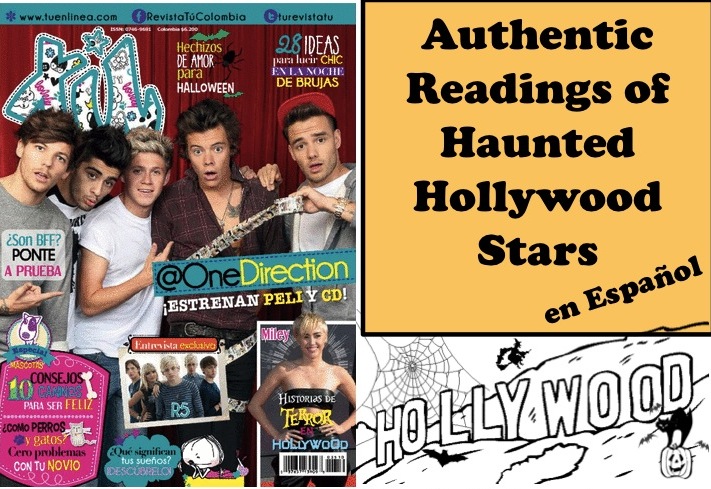
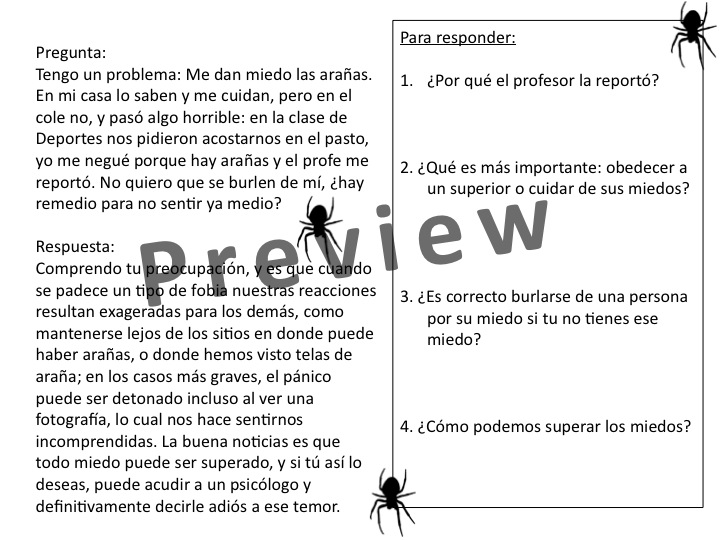
We’ve recently added 2 products featuring excerpts from a Colombian magazine. The first one talks about Hollywood stars such as Justin Beiber and Lady Gaga’s experiences with ghosts. The second one features teen asking questions about their fears with responses from the magazine. Each features questions so you can use print them and use them in your classes right away.

Spanish Halloween Activity Phobias
example:
Miedos Fobias Preview

This twiccionario de Zachary Jones features authentic tweets in Spanish about fears.

tengomiedotuits

Our favorite reading has been this article from Univision that compares Halloween and Day of the Dead titled Calaveras contra calabazas.

This reading is in English, but it discusses Disney’s request to copyright the name “Day of the Dead” which may provoke some interesting discussion in class.

Actividades:

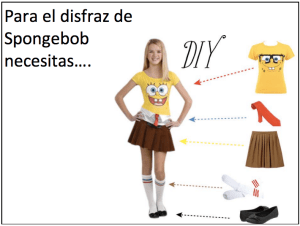
Disfraces Students describe Halloween costumes in SpanishWe practiced Clothing Vocabulary as we talked about Costumes. Students had to describe what clothing made up each costume. You can download a free powerpoint of 12 Halloween Disfraces and then have students make up their own to describe to the class. For upper levels, you could even make up a game by having students guess what the costume is.

Chistes Graficos e Imagenes:

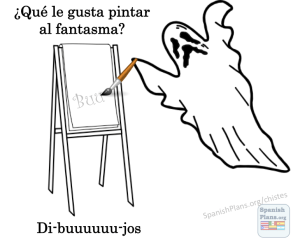
Dibuuuujo joke

The blog Confesiones y Realidades has composed a post of 15 comics including the one to

terapia para zombis

the right.

Day of the Dead Galleries: Look at pictures taken in Mexican cemeteries as people practice the traditions of Día de los Muertos.

2 Infographics, including one which compares Day of the Dead with Halloween.

Videos:

Día de los Muertos video from misCositas.com (Download the script of this video).
Muertos Vivientes

Links:

Language Teachers’ Cafe blog has a post of 5 Ways to Celebrate Día de los Muertos.

The blog Teaching Spanish w/ Comprehensible Input has a list of 23+ Activities for Halloween and Day of the Dead.

*********************
^Article from univision.com “Calaveras contra calabazas“. This article discusses how Día de los Muertos is being overshadowed by the North American celebration of Halloween, especially in the younger generations. The 3 page article is definitely manageable for all levels of Spanish. Although upper levels would have an easier time with it, I plan on having my level 1 students read it and look for cognates and read for context.

^Day of the Dead Galleries: Look at pictures taken in Mexican cemeteries as people practice the traditions of Día de los Muertos.

^Make your own sugar skulls: Follow this recipe and learn about making las calveritas.
^Make your own pan de muerto: Follow this receipe to make your own “dead bread”.

How will you celebrate “Día de los Muertos” in your class? Please post a comment below with your lesson for the day or any other resources you wish to share!

Posted in Culture, Resources | Tagged , , , , , | 3 Comments

Family Tree Spanish

I think we can all agree that the textbooks’ family trees are as engaging as an 8 a.m. lecture in a lecture hall of thousands. After a few years of using my own personal family to teach the family vocabulary words, I’ve instead started to use families that the students are somewhat familiar with (although I refuse to do the Kardashian family).

The Simpsons is one of those shows that includes a nuclear and extended family with enough people to fill out all the vocabulary words. Take a look at the following picture (blank and filled in).

LosSimpsonFamilia

Click to view/download

Pin It

LaFamiliaSimpsons

Click to view

After the jump, check out our Modern Family Family Tree based on the hit ABC sitcom Modern Family and other family related projects and lessons….

Continue reading

Posted in Lesson Plans, Resources | Tagged , , , | 1 Comment

Free Spanish Worksheets

Among our hundred of products, are also many free items. In addition to these completely free worksheets and materials, a majority of our priced items include a free preview for you to get a sense of the product to see if it would be beneficial for your class. All you need is a free login to be able to download hundreds of materials for your Spanish class.

Our Free Products:
*Telling Time : Notes and Quiz – Short 2 pages document. 1 page describing how to state the time in Spanish and another page a brief quiz.
*Teaching Location in Spanish with Magnets – Explains how to use a magnet board to teach prepositions of location. To learn more about this activity and how to use it, read our explanation.
*Chores Vocabulary student oral activity – 20 questions for students to ask each other regarding chores and what they have to do around the house. Students ask the question orally and write down the names of their classmates according to their responses.
*Preterite of AR Verbs Guided Notes Packet -4 pages explaining the use of preterite and the forms for -AR verbs, including the forms for -Car, -Gar, -Zar verbs. Answer sheet also included. Preterito ARMakes understanding the preterite so much easier for the students. One you download these, you will definitely want to check out our -ER/IR packet for the preterite for only $4.00. Not convinced, just download the free preview (‘Download Preview’ button for free sample is always below the price on the product’s page).

While you are at it, I highly recommend checking out the free previews on our top sellers to see if the product is worth your money. The time it will save you in planning alone will be worth every penny. And because our products are classroom-tested and teacher-created, we’ve cut out the middle-man of big publishing companies and bring the worksheets and lessons right to you at a very affordable price!

*Preterite Pack: El preterito
*15 Spanish 1 Projects
*Subject Pronoun Unit
*Conversation Cards Levels 1 & 2 -Oral Speaking Activity

Posted in Free, Resources | Tagged | Leave a comment

Hanging up Flags in Classroom

Over the last several years, I have been purchasing large 3’x5′ flags of Spanish Speaking countries, for display in my classroom. You can find them for pretty decent prices on ebay. The only problem was the lack of wall space, or more frustratingly, a way to keep them up. I used to tuck them into the ceiling tiles and let them hang against the back of the wall. I also have metal frames around my windows, so I buy Magnetic Clips and hang them over the windows.

But I have one area of the room, with a lot of empty space and I was unable to do either of those. That’s when the following three items came in handy:
How to hang up a flag in your classroom3M Command Hanging Clips, a tension rod, binder clips

For less than $10 you can get all of these and use them to hang your flags. The Clips are about $5 dollars for a pack of 6. And they will stick to anything. I have used them against cement brick wall, actual brick walls, and drywall and it stays put, but you can take it off without leaving marks. It really works! Go to the curtain or shower rod aisle of your favorite department store and pick up a tension rod for $5-10 depending on the size. And what teacher doesn’t have binder clips laying in some desk drawer. Attach the Hanging Clips to the wall, clip the flag to the tension rod, and wham!, you have yourself a flag that isn’t going to fall down.

Easy solution to Hang flags in school How to easily hang up flags in your classroom
Easy way to decorate your classroom for cheap! For other decoration ideas for your classroom, check out our Bulletin Board posts.

Posted in Bulletin Boards | Tagged , , | 14 Comments

Columbus Day

Most schools around the country have Monday off in recognition of Columbus Day. In Latin America, most countries also recognize this day as “Día de La Raza“, although in Costa Rica it is called “Día de la Culturas” but in Venezuela it is referred to as “Día de la Resistencia Indígena” to reference the plight of the indigenous population who inhabited Columbus Day Genocide Daythe lands before Columbus’s arrival.

Many of our students learn in school that Christopher Columbus, or Cristóbal Colón, “discovered America”. We know that this claim is not true and I believe it is important not to dumb down the facts for our young learners. So where did Columbus land?

Colón made 4 voyages to the Americas between 1492 and 1504.

  • He first voyage included landing on the islands of the Bahamas (which he called San Salvador), Cuba, and the Domincan Republic, which the whole island at the time was called “La Española”. This island now includes Haíti.
  • His second voyage a year later included stops in Antillas Menores, Puerto Rico, Cuba, Santo Domingo and Jamaica.
  • In 1498, on his third voyage, he landed upon Sur de Trinidad, la Península de Paria, and Santo Domingo.
  • Between 1502 and 1504 he set foot on Cuba, Honduras, Costa Rica, Panamá and Jamaica.

    ColumbusDayMap

    Click to enlarge

Columbus was an Italian, who set sail on behalf of the Spanish Crown, in search sailing to India. Because he thought he landed in India, he called the people he encountered “indios”, where is why we refer to indigenous people as “Indians”. The European contact with the “Tainos” would ultimately lead to their near extinction.To his death in 1506, Columbus believed he had landed in the Indies,  and was unaware of having discovered a new continent unknown to Europeans.

Hispanic Holidays : Download this list to see what Columbus Day is called and when it is celebrated in the rest of América.

Dia de la Raza

Update:
Check out these article talking about why it is time abolish Columbus Day and that honoring a greedy, ruthless, genocidal, slave-trader with a federal holiday seems a bit Dia de la resistencia indigenastrange.

Many cities are now celebrating “Indigenous Peoples’ Day” on October 12 instead of Columbus Day. Good Move.

Posted in Culture, History | Tagged , , , , | 2 Comments

Jesse y Joy Corre

¡Corre! por Jesse y Joy

Letras de la canción “Corre” de Jesse & Joy, which was released October 5th. Their new
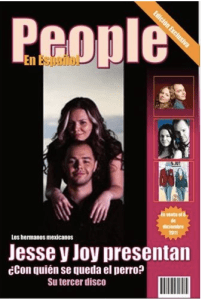
Compra este póster de J y J

album, ¿Con quién se queda el perro? will be released October 25th December 6th. Their third album follows the debut album “Esta es mi vida” and their hit album “Electricidad”. You can purchase the first single “Me Voy” and the latest single “¡Corre!” in the iTunes Music Store. For more information see their official website at www.jesseyjoy.com

Letras de ¡Corre!

Me miras diferente,
me abrazas y no siento tu calor.
Te digo lo que siento
me interrumpes y termias la oración,
siempre tienes la razón.

Tú, libreto de siempre tan predecible
ya, ya me lo sé

así que corre, corre, corre, corazón
de los dos tú siempre fuiste el más veloz
toma todo lo que quieras pero vete ya
que mis lágrimas jamás te voy a dar

así que, corre como siempre, no mires atrás
lo has hecho ya y la verdad me da igual

ya viví esta escena
y con mucha pena te digo no. Conmigo no.
Di lo que podía, pero a media puerta se quedó mi corazón

Tú, libreto de siempre tan repetido
Ya no, no te queda bien

Así que corre, corre, corre corazón
De los dos tú siempre fuiste el más veloz
Toma todo lo que quieras pero vete ya
Que mis lágrimas jamás te voy a dar

Así que, corre como siempre, no mires atrás
Lo has hecho ya,
y la verdad me da igual

Tú el perro de siempre los mismo trucos
Ya, ya me lo sé

Así que corre, corre, corre corazón
De los dos tú siempre fuiste el más veloz
Toma todo lo que quieras pero vete ya
Que mis lagrimas jamás te voy a dar

Han sido tantas despedidas que en verdad
Dedicarte un verso más está de más

Así que corre como siempre,
Que no iré detrás
Lo has hecho ya, y la verdad me igual
Lo has hecho ya, y la verdad me da igual
Lo has hecho ya, pero al final me da igual


To view a video, with lyrics, visit their YouTube page. This song is a great song to use in your Spanish classroom to have students listen to to fill in lyrics. Create a cloze activity by taking out selected words and having students listen to the song to fill in the blanks. The song is nice and slow, and easy for beginning students to follow and the lyrics are easy enough to follow along! Great lesson for Spanish 1 music lesson.


Posted in Music | Tagged , , , , , | Leave a comment

2 de Octubre No se Olvida

While reading the trending topics in Mexico on Twitter, I noticed one Called “no se olvida” and “2deOctubreNoSeOlvida“. Upon reading some tweets, I recalled the monument I saw in Mexico City in the Plaza de Tres Culturas. Known as the “Tlatelolco massacre” the government opened fire on students and civilians who were protesting the 1968 Summer Olympics that were set to begin in Mexico. The monument lists the names and ages of those who were known to have been killed, although many more are unlisted as it is unknown exactly how many were killed. It is believed hundreds were killed during this protest. This was Mexico’s Kent State, soldiers unprovoked firing on civilians during a protest. For this, we must Never Forget. 2 de Octubre 1968 Mexico For more information, you can read about the event here and here.
Infografía del Dos de Octubre.

Otro infografia

Posted in Culture, History | Tagged , | 1 Comment

Saber

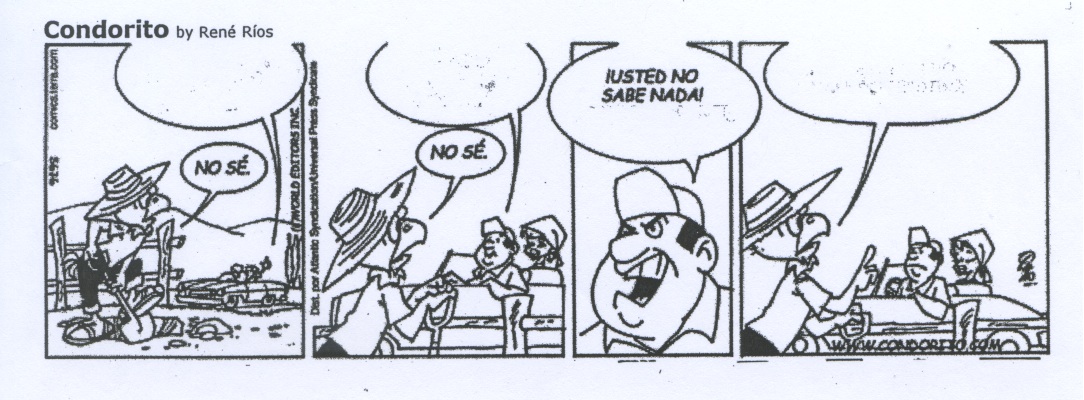
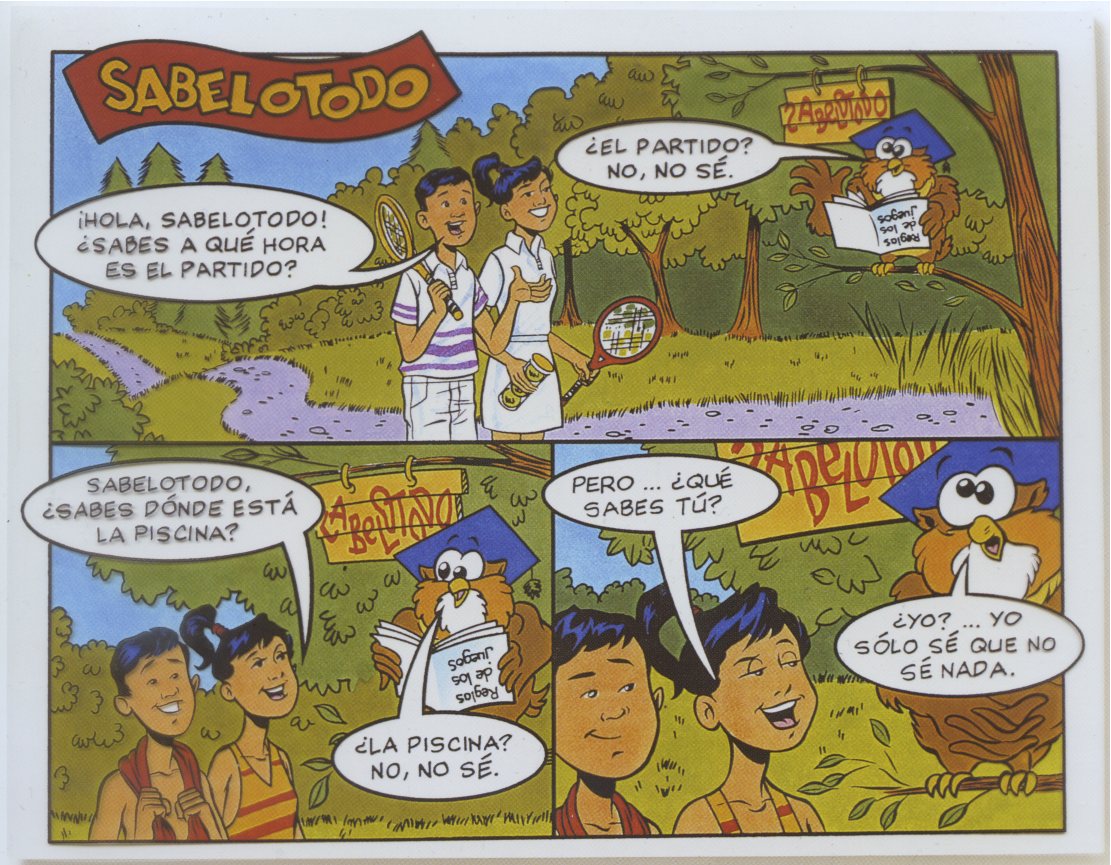
After introducing the verb saber, I post the following comic on the board as students enter the room. After they have read about “sabelotodo“, “know-it-all”, I ask them to create their own comic with the verb saber.

Students use this Condorito comic strip to write in the questions and the final response.
Click on each picture for a larger version, which you can download and use in your own classroom.

Posted in Chistes | Tagged , | 1 Comment